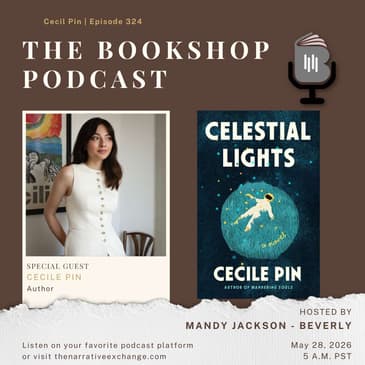
In this episode, I’m joined by Cecile Pin, the acclaimed author of Wandering Souls, to discuss her latest novel, Celestial Lights, and the deeper questions it raises about identity, ambition, and what we sacrifice when we decide who we want to become.
Cecile takes us from her multicultural upbringing in Paris and New York City to her study of philosophy in London. We dig into how living between cultures can give a writer real creative range. We also get specific about craft: what it means to write in English as a second language, why rhythm matters, and how she thinks about “show, don’t tell” when emotional truth demands something sharper.
Cecile and I chat about moving from publishing to writing her own fiction, the vulnerability of touring a deeply personal debut, and why she started Celestial Lights, hoping for distance, only to find that the heart always shows up.
From Europa research and NASA details to astronaut memoirs, mission constraints, and the novel’s alternating space logs, Cecile shares how she built a believable world without turning the book into a textbook. If you love literary fiction, speculative sci-fi, and character-driven novels that stay grounded in relationships, you’ll find plenty to take with you.
Subscribe for more author conversations, share this with a friend who loves books, and please leave a review wherever you listen.
The Bookshop Podcast
Mandy Jackson-Beverly
Social Media Links
Show Updates And Live Venues
SPEAKER_01Hi, I'm Andy Jackson Beverly, founder of the Narrative Exchange, featuring the Bookshop Podcast, the Lunch with an Author literary series in Southern California, writing workshops, and the Narrative Exchange Book Club. Here at the Book Shop Podcast, I explore the world of books through conversations with authors, independent bookshop owners, booksellers, and publishing professionals who keep literature alive. If you enjoyed the show, please subscribe, share it, and leave a review wherever you listen. You're listening to episode 324. You may have noticed that I've had longer gaps between episodes, and I apologize for this, but it's for a good reason. The in-person events have grown and they're taking a lot of my time. And I don't want to stop the bookshop podcast. So I'm just going to slow down a little bit with the episodes. I have quite a few recorded in the wings, so they will be on in the next couple of weeks. As I mentioned recently, I now have partners for the Lunch with an Author Literary series. In Los Angeles, as of September, the luncheons are going to be held at VIFA Art Gallery, which is an amazing art gallery in LA South Bay. If you haven't been, check it out. Their website is VIFAGallery.com. In OHI, I've partnered with Zina, who is the founder of Magic Hour in OHI Riding Town. It's the most exquisite tea store. Well, tea shop kind of doesn't do it justice to say that, but check them out at magichourohi.com. And come and join us for one of our luncheons. It's fabulous food and delicious teas. And since the beginning of 2026, I've partnered with the University Club in Santa Barbara. Another great partnership. Now you can get all of the tickets for these events by going to thenarrativeexchange.com. Just click on the events page and you can get your tickets there. I feel like I finally landed with these three venues and partnerships. It means a lot to me. So thank you to Magic Power, VIFA Gallery, and the University Club in Santa Barbara.
Meet Cecile Pin And Her Novel
SPEAKER_01Okay, let's get on with this week's episode. Cecile Pin is a writer living in London. Her debut novel, Wandering Souls, was published in 12 languages. It was longlisted for the Women's Prize for Fiction, the Prix Femina Étrange, and shortlisted for the Waterstone's debut fiction prize. She has won the Fragenod Prize for Foreign Literature, a Somerset Maum Award, and a London Writers Award. In 2025, she was selected as one of Forbes' 30 under 30 Europe. Her second novel, Celestial Lights, was published in March 2026. Here's a short synopsis of Celestial Lights. January 28, 1986. Soon after launch, the Challenger shuttle falls out of the sky and into the sea. At the same time, Oliver Innes is born. Celestial Lights is his story. Olli spends his childhood in an English village where his bedroom is covered in glow-in-the-dark wallpaper bearing the planets and stars. Decades later, he has become one of the most renowned astronauts of his time. When an enterprising billionaire taps him to lead a landmark mission to the distant moon Europa, Olli makes a choice that will send his whole world spinning. Hi Cecile and welcome to the show. It's fabulous having you here. Hi, Mandy. Thank you so much for having me. I know I've already told you this, and I've told many other people who I've spoken to in our book club and at the literary luncheons. Celestial Lights is one of my favorite books of this year. It is a phenomenal, beautifully written, exquisite book. And so congratulations on that.
Growing Up Across Paris And NYC
SPEAKER_01Well, let's begin with learning about you and your life growing up in Paris and New York City before moving to London to study philosophy at University College London.
SPEAKER_00So I'm I'm very lucky that I grew up quite multi-multicultural. My mom was Vietnamese as well, and I moved to New York when I was nine, and um that allowed me to learn English. I didn't speak English before moving there. And I think it's such a blessing to grow up with, you know, different cultures and getting to meet different kinds of people. Um I think as a writer as well, it's it's allowed me to feel a certain kind of freedom in what I write and being able to not feel like I'm I need to stick with one, you know, cultural or literary heritage, and I can kind of pick from different um writers or styles that interest me. And I think you can kind of see that with my first book and second books who have quite different topics, and I think that comes from you know having grown up with different cultures and in different places and kind of um not limiting myself to one literally literary um style.
SPEAKER_01To be given the opportunity to live and work in another country is such a blessing and a privilege.
Writing Beyond Show Don’t Tell
SPEAKER_01As writers, we're often taught uh show, don't tell, but your prose feels like it operates beyond that binary. There's like a philosophical density to how emotion is rendered. How do you think about form when trying to express something interior or ineffable? Do you ever consciously resist conventional writing advice when it conflicts with emotional truth?
SPEAKER_00I think so. I think writing in your second language is um you always feel like a student, and I'm always trying to feel like I haven't mastered English yet. And I think with that comes a certain sense of I'm always trying to improve myself. Um also I think there's something about writing in a language that's not the language of your childhood that helps you maybe, you know, get loose a bit more and um lose your inhibitions a bit, which I think is very important when you're writing a novel. You need to feel again that that kind of freedom and you need to feel safe and like you can explore. And so I think maybe writing um in English has helped with that. And also maybe seeing the language in a slightly more objective way. And and I'm always conscious when you're talking about form, I think rhythm is quite important when I'm trying to write as well. And and how does a sentence sound, you know, and I I love that's something that I love about the English language. It has a certain flexibility, maybe a little bit more flexible in the French language, which has a lot of gravitas in some ways. And I find English very lyrical, which I think kind of fits my style a little bit. So yeah, I to go back to the show don't tell question, I definitely try and keep to that as a as a rule as well. But I I also think um I love novels as well. When, and especially Ollie, my my protagonist, he's quite a restrained character in itself, and the novel is told in first person. So he's not someone who would tell his emotions in some ways. But um, I wanted at the end for him to have that moment of tell where he kind of voices for the first time out loud his his doubts and without wanting to spoil a little bit. So I think a very carefully picked, like, tell moment in a novel can be effective, but you have to really use them quite sparingly.
SPEAKER_01Ah yeah, I really love what you've just said, and it's given me a lot to think about.
Publishing During COVID Then Writing Fiction
SPEAKER_01Now, you worked as an editorial assistant before becoming a novelist. At what point did you move from shaping other people's stories to needing to tell your own? And what made fiction the necessary form?
SPEAKER_00So I was an editorial assistant during COVID. So um, and I I think being around fiction, I worked at Jonathan Cape with I worked uh, you know, I was I was lucky enough to work with writers like Ian McKillen and Ocean Vong and Ottasa Moshbeg at an assistant level. So I wasn't their editor or anything, but just getting to read their work, and I think it made the whole literary world and publishing world a bit less intimidating because it can be very scary, I think, and and people don't really know how it works at all. And so I feel very lucky that I had that this experience. And during COVID, like a lot of people, I was quite privileged to have more time. And and I had that story um of my my mom who was a Vietnamese boat person and who left Vietnam to settle in France in the late 70s, early 80s, and she lost um um her parents and younger siblings at sea. Uh so I always knew that I wanted to write about this family event in one way or another. Um, and I wasn't sure if it would take the form of fiction or if I would maybe become a journalist or maybe do a PhD and and and in some way explore the Vietnamese diaspor and the and the Vietnamese boat people. But um I think again being immersed in the world of fiction through my job at the time and made me take the leap in that direction. And I also think that fiction in that sense allowed me, again, what I said about losing your inhibitions, to to take that very personal story, but also have the creative freedom to make it my own and to not feel so weighed down because I was writing my family story. I so I I transported the story to England instead of France, and the characters became their own person, and having that kind of mix of fiction and nonfiction, I think, was both mentally better for me, and also uh writing-wise, just more um I got to be a bit more creative.
SPEAKER_01I enjoyed the form of your writing, uh, especially how you've kind of put in Ollie's own little diary writings throughout the novel. Absolutely beautiful.
Protecting Yourself While Drafting A Book
SPEAKER_01You were just talking about Wandering Souls, your first novel, and drawing from your mother's family. With celestial lights, the emotional landscape feels kind of more interior and existential. Where, if at all, does your own story surface in celestial lights?
SPEAKER_00Thank you. Um celestial lights, of course, is much less personal in lots of ways. It's about an astronaut, a male protagonist who embarks on this tenure-long mission. Um, I began writing it as I as Wondering the Souls was coming out, and I think there was a little bit of a desire for me to write something that was less personal and to kind of think less about me in some ways. And so I began Celestial Lights with that kind of in mind and wanting to almost protect myself because I was on a book tour for a very personal book, and I was like I was talking about my family and my story for a long time. And with celestial lights, I thought, oh, this will be nice because it'll be like writing something that's got more distant from me. But of course, as I was writing it, I started to creep into the story and NXT. I think that just happens. And also, I think that writing needs to come from the heart, right? And so when I started admitting to myself that there were some similarities between Ollie and me in that story, that's when writing it became more fun and when the book came together. So I think both Ollie and I were quite introverted people in some ways. We both left our family home at 18 to go study in London. I think I was also writing the novel while my writing career was was, you know, ticking off a little bit with I was on tour for Wandering Souls, as I said, and in the UK. And I think I was also uh, you know, in a relationship and in uh just thinking about how to manage those ambitions with your personal life and with your relationships and what how much of yourself do you want to give into your career and to your your private ambitions? And so I think that was very much on my mind as well, all of those questions, and and I think that infused the book.
SPEAKER_01I love what you just said about writing from the heart. I think that as a reader, I've often found little fragments in novels where I can tell that the story has truly come from the heart of the author. You were saying how you started writing celestial lights while out on tour for uh wandering souls. Was it difficult for you to let go of the residue from that extremely personal book? And then switching into conversations with readers about the book without you feeling all that residue, all that kind of dust from your family's suffering. Was that difficult for you?
SPEAKER_00It can be difficult, but it's also such a blessing, and I feel so grateful that I got to meet readers, and I, you know, I still get people from Wandering Souls telling me that you know it was the first time they felt they were represented in a book, and that the book was also their mom's story, and the book allowed them to open this dialogue between them and their parents for the first time. So and that's so that's beautiful. And I I feel so yeah, it's um emotional for me. And I think it really also for my family like helped bring the tragedy full circle and you know, having something a little bit positive come out of it. So it's um so yeah, I because there were days where I was like, oh my god, I was so tired and so emotionally exhausted, strained as well, but I have to kind of keep reminding myself that it is it's a privilege, and it's um yeah, and I'm very glad that I I wrote the book and feel very blessed that it had some readers.
SPEAKER_01And also I feel that by talking about the suffering that our ancestors have lived through, it helps break that cycle of inherited suffering. Obviously, we're never going to forget it. We can't forget those uh traumatic events in our ancestors' life, but by understanding their pain, it is a little easier to bear.
Building A Self Without Anchors
SPEAKER_01Um, I want to talk about Ollie because he's often perceived as making selfish choices, yet the novel carefully reveals his internal fragmentation and his desire for self-definition. When you wrote passages like the one I'm about to read from page 37, were you discovering him in real time or articulating something you already understood about him? Uh, here's the paragraph I'm referring to. Quote That urge I had in London to work out who I was without any anchors, without anyone who reminded me of home, I wanted there to be a place empty of anyone able to show me my reflection so that I could forge it myself. End quote. That is such a beautiful paragraph. And it says so much about Ollie's uh demeanor and his personality. Can you share a little bit about that with us, please?
SPEAKER_00Um, thank you. Yes. So, and I think there are different ways you can read that, right? I think either you see him as almost being a bit deceiving in a way that he wants to create this new personality for himself as he enters adulthood and and wants to let go of his past and his childhood self and and you know uh his kind of ambitious self wants to to be someone new. Or also I think that's something that I definitely felt a bit when I was when I again moved Contra at 18. And I hated school and I hated being a teenager and that feeling of okay, I can kind of let that go and have a second chance and and kind of gloom a little bit uh in in a new place. Uh and I think that's something we all a lot of us have. And um I think Ollie is also a character who is very aware of the expectations that are put on him and very kind of conscientious about what he thinks he ought to do, um, maybe too much and instead of thinking what he wants to do. And I think that um because of that weight of expectation, he feels he doesn't feel able to be completely himself with whether it's with his parents or his friends or the people around him. And that's taxing, right? And so I think that he's hoping coming to to London and and letting go of his childhood self a little bit, that he'll be able to create this self that feels both true to him but also true to what people expect of him.
SPEAKER_01And did you feel at all like that when you moved away from your family from New York to London?
SPEAKER_00I gosh, it was 10, 11 years ago now, but I was I was so shy growing up and at school. And I grew up as well with two sisters very close to me. Well, one sister especially very close to me in age, and I think Yeah, it's hard because you always get compared to to your siblings, and I think um I wasn't an I wasn't a very good student either. I was a bit of like your typical kind of glasses, braces, like bloomer child, and and I think I I loved London straight away. It was hard. It was hard being away from home, but I made I met my best friends that are still my best friends, like the first week of uni, and and I I grew up so much that first year, and and I I I was still shy, and I still am quite shy, but uh I think I definitely came out of my shelf a bit more and gained so much in confidence as well.
SPEAKER_01There's a part in the book where Ollie expresses a desire to exist, quote, without anyone able to show me my reflection, end quote. It's such a striking idea, and it's like identity formed in isolation rather than relation. What drew you to that tension? And do you see it as ultimately liberating or destabilizing?
SPEAKER_00That's a good question. I think definitely um and you have that as a as a writer as well. I think people are so keen in general to put you into boxes, and you know, like you're right, like sci-fi or literary fiction or historical fiction, and I I guess maybe that's something that I was talking about earlier as well. I um growing up in different countries and with different cultures, I I always try to resist being put in boxes because I I've been lucky to kind of be exposed to different kinds of boxes in uh in my life. And I um I think that with with Ollie too, again, it's that idea of losing your inhibition and not wanting to be defined by his past, by his parents, by the expectations put on him, or by where he comes from, and wanting to figure out who he is as a kind of blank slate. And and I think that's something that we all feel a bit when we're in our early 20s, late late teens, and that feeling of trying to figure out more about who we are, really. Yes, it's scary and exciting. Yeah, definitely. It's it's it's kind of like a dizzying sense of freedom in some ways, I think. You know, I think sometimes in life you have moments where you're trying to figure out more about your past and your identity and where you come from, and then you've got moments where you're trying to not think so much about these things and you're trying to look more towards the future and all these things, and it's about finding that balance between the two while also staying in the present.
SPEAKER_01Yes, absolutely.
Space As Psyche And As Setting
SPEAKER_01Uh, the idea of space in celestial lights feels less like a setting and more like an extension of the psyche. That's how it felt for me. Were you thinking of the mission as a metaphor for interior exploration?
SPEAKER_00Yes, I I knew I wanted to write a book about space, but we're almost space wasn't the main focus of the novel. Uh, you know, some of one of my favorite writers is Kazu Shiguro, uh, you know, never let me go. I love that book. I love how he manages to have that sci-fi element, and while always keeping the characters and the relationships at the center of the novel. And I wanted to write um a book that had that dichotomy between something that's kind of out of this world literally, but still feels very grounded and humane. So um, and space uh allowed for that contrast, you know, in a in a very kind of fun way to write about as well. And and Ollie's wife as well, Philly, is someone who's a biologist who's focused on the everything that's earth-related and on really much the living things, and and it was fun to write about those two different characters and uh getting to write, you know, Ollie's space logs, for example, which are kind of written in this colder style and which explores both the vastness and the wonders of the universe, but also the coldness of it. And then contrasting that with kind of the natural world and and everything that is precious about Earth, whether it's our relationships, our loved ones, but also nature.
Researching Europa And Astronaut Life
SPEAKER_01Cecile, I'm guessing you did a lot of research for this story. Can you tell us about that, please?
SPEAKER_00Yeah, so I um I started with maybe about six months of research before writing. Um so my alma mater UCL allowed me actually to um attend some of their astrophysics and planetary science lectures, which was such a treat because I I'm really I did not know anything about You know, I'm I've always been very bad at physics and science. So just getting a bit of basics and groundings. And then it's through the research really that I got the plot, right? So for example, it was during lectures that I thought that Europa would make for a good um destination for Ollie because it's because Europa is considered the next step after Mars for exploration. And you know, it was kind of an ideal setting that's not too close to reality, but still feels like not too out there for the setting of the novel. Um, I also read this book called The Future of Humanity by Michelle Kaku, which is a nonfiction book which um kind of helped me learn a bit more about the challenges that space travel faces, like radiation and how to fuel spacecrafts. Um Tim Peak's memoir. Tim Peak is one of them um a British astronaut. Uh and I watched lots of videos of astronauts as well to get the you know the movements and the descriptions right. Um and then also just the NASA website, it's so detailed, and I got lots of info from there. Um, I think with research, it's always hard to get you do so much research and you want the reader to feel like he's in good hands and you want the novel to feel informed, but you also then have to not not put that much research in the novel because it would be quite boring if there was too much research in it, I think.
Mission Logs And The Odyssey Influence
SPEAKER_01We spoke earlier about the form of your writing in this book, and there's a part where the Phoenix mission personal log uh kind of comes in and out of the story, but it creates both intimacy and constraint. It's personal but also selective. Did this form emerge organically from the story, or did it shape the story once you chose this style?
SPEAKER_00I think quite early on I settled on that um format. So so you've got the main narrative thread, and then every few chapters you've got that space log, which details the mission. Um so the the book is partly loosely inspired by the Odyssey, which so it's um which I was reading at the time. I was reading Emily Emily Wilson's new translation, and um I love in that epic, how what you know the Odyssey for really the you know Circe and Beliefemus, the Cyclop and the Sirens, how it's very condensed, actually. And it's a lot of the Odyssey is is Odysseus going from place to place and and you know having a drink for the gods and everything to the gods and everything, but actually the action is very condensed. And I I was interested in also condensing the mission logs into actually not making it the main focus of the book, um, and instead having them in those space logs every few chapters. Um, they also allow to show another side to Ollie. I think the main narration is him very much reflecting on his life. And I don't think he's he's completely unreliable as a narrator, but you do also have that doubt on how much should we take at face value what he's saying. You know, it's totally in the first person, and it's him trying to justify to himself as well some of his actions in his in his past. Um, and whereas the space logs allowed for a kind of more direct, aloof way of for him to speak, and we get to see this glimpse of him as what what he's like as a commander um as an astronaut on this tenure-long mission with only three other people for for companionship.
Rhythm, Redrafts, And Plot Skeletons
SPEAKER_01What I love about your prose is that it's remarkably precise yet lyrical. Now, when you're writing, are you primarily driven by rhythm, meaning, or image, or do those emerge simultaneously?
SPEAKER_00Thank you. Yeah, I think I think that all of those elements you mentioned come kind of simultaneously, and I'm not always aware of you know all of them. And I I guess sounds a bit cliche, but I just try and write the best book or chapter that I can in some ways. And as I mentioned, I am quite aware of rhythm and kind of how sentence sounds, and maybe that comes from having learned the language a bit later. But um, there's so much redrafting that comes with writing as well. And I think it's Tara Pratt that said that the first draft is you telling the story to yourself, and then the next drafts I'm thinking, okay, how do I make sure that all of the kind of side characters feel very much like fleshed out? How do I, you know, does the plot make sense? How do I make the writing as best as it can be as well? Um, and I like to plot, so I usually uh will start with a very broad idea of what I want the book to be, you know, the themes, the the main character, some some vague ideas, but then it's through the research that I usually come up with a plot. So maybe a rough chapter breakdown, something like that. And then as I write, of course, you have to allow yourself the flexibility of knowing that things might change as the characters kind of become more clear to you. Um, because I yeah, I I think the more I think I I have some writer friends who just are very clear on who their characters are before they start writing the novel. But for me, it's very much the more I spend time writing them, the more they become kind of real and like almost like friends in my mind. And so you have to know that some things might change as as the more time you spend with this with this story and the characters. But but I think for for both my novels, actually, the the skeleton that I'd made was remained kind of roughly the same throughout the whole process. And it was mu um the editing and redrafting process was more about adding things and making the story really come to life.
SPEAKER_01And how did you fall into this story?
SPEAKER_00I think I was just curiosity, really. I've always I've I've never been one for sciences, but I've always been quite fascinated by by the universe and our galaxy. You know, it's something that is both all-encompassing that surrounds us, you know. I mean, down to the fact that our bones are made of the remains of stars, and yet there's so much that we don't know um about the cosmos. And I think that kind of sense of wonder but also mystery is was very tempting to write about that uh as well. And and I think, yeah, as I mentioned, I was interested in writing a novel that had that kind of speculative sci-fi element, um that contrasted with kind of characters and and that focused on the humane and on relationships. And and I I just thought that would I was interested in seeing if I would be able to do that. And it was kind of a uh after I think Wandering Souls, it was kind of a different kind of writing challenge, and um it was it was fun, it was hard, but it was a fun book to write.
SPEAKER_01And you said you did six months of research. If you look back, how long do you think the book took you from start to finish?
SPEAKER_00Oh gosh. Um, I'm trying to think now because it was a bit, I think I took a few breaks in between, but maybe three years.
SPEAKER_01Well, you have written a beautiful book, Cecile. Uh, Celestial Lights is absolutely wonderful. Thank you so much, Mandy. It was so nice to talk to you.
Final Thanks And Where To Follow
SPEAKER_01You've been listening to my conversation with author Cecile Pinn about her latest novel, Celestial Lights. Thank you for joining me on the Bookshop Podcast. This show is written and produced by me, Mandy Jackson Beverly. With music by Brian Beverly, my personal assistant is Kaylee Ditchinger, and my graphic designer is Alexandra Mooney. If you enjoyed the episode, please follow, share, and leave a review wherever you listen. For more information, go to www.thenarrativeexchange.com. Until next time, here's to the books that shape us and the bookshops that bring us together.