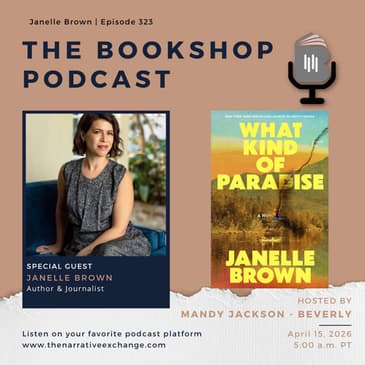
A teenage girl grows up in a Montana cabin with no school, no neighbors, and one constant lesson from her father: modern life is a trap and authority is the enemy. Then she finds a photograph that doesn’t fit the story she’s been told, and the only way to learn the truth is to run straight toward the world he fears most: 1990s San Francisco at the birth of the internet boom.
In this episode, I’m joined by New York Times bestselling author Janelle Brown to talk about her novel What Kind of Paradise and the real-life early tech era that shaped it, from Wired to the first wave of digital optimism. We get into why writing about technology in the present tense is so hard, and what it means to look back on the web’s “revolutionary” promise after decades of addiction, distorted discourse, and an always-on life.
We also go deep on craft, character, and point of view. Janelle explains why she wrote the father’s backstory in second person—the "you" voice—making it a psychological shield and a subtle manipulation. For this novel, Janelle researched extremism, including works on Ted Kaczynski, while still making a complicated father feel frighteningly human. Along the way, we unpack legacy, parenting, identity, and her sharp question for all of us: how much are we letting technology dictate who we become, and what guardrails do we actually want for AI and platforms?
If you like literary thrillers, author interviews, and big conversations about technology and society, hit play, then subscribe, share the episode, and leave a review wherever you listen.
The Bookshop Podcast
Mandy Jackson-Beverly
Social Media Links
Janelle Brown And 1990s Tech Dreams
SPEAKER_01Hi, I'm Mandy Jackson Beverly, founder of the Narrative Exchange. Featuring the Bookshop Podcast, the Lunch with an Author literary series in Southern California, writing workshops, and the Narrative Exchange Book Club. Here at the Bookshop Podcast, I explore the world of books through conversations with authors, independent bookshop owners, booksellers, and publishing professionals who keep literature alive. If you enjoy the show, please subscribe, share it, and leave a review wherever you listen. You're listening to episode 323. Okay, I have a few items to check off before this week's interview, so here we go. Does this sound familiar to you? One day, 50 states, 2000 plus bookstores. Yep, join the fun on Saturday, April 25th and celebrate the 13th annual Independent Bookstore Day. This national one day party held the last Saturday in April celebrates independent bookstores across the country, online and in store. Through exclusive books and literary items, contests, cupcakes, and everything in between, it's a party you don't want to miss. Buy local, read global, and support your local indie bookshop. I recently partnered with Zina Muzika, founder and owner of Magic Hour in Ojai, California. On Wednesday, April 22nd, I'll be in conversation with author Emily Franklin about her beautiful new book, Love and Other Monsters. And Chef Noah will be enticing our guests with his delicious, mouthwatering and beautifully plated three-cost luncheon while Zina and her crew tempt us with their divine teas. While meeting with Zina and her team recently, Zina asked me what I'd like to drink, and I answered, something cool, fruity, and caffeine-free. She thought for a moment and said, ah, yes, I know what you need. She promptly jumped up and made me a drink that I'm still dreaming about. Of course, I bought a bag of this tea to take home, and it's called Seraphim's Dream Tea, and I highly recommend it. In fact, I'm drinking it hot right now. This tea seems kind of magic because when you first make it, it's a dark indigo. But if you add a drop of lemon juice, it becomes purple. It's gorgeous. For more information about the Lunchworth and Author literary series, go to thenarrativeexchange.com. Book your tickets now because the events book quickly and we have limited seating. Here's this week's interview. Janelle Brown is the New York Times bestselling author of the novels What Kind of Paradise? I'll Be You, Pretty Things, Watch Me Disappear, All We Ever Wanted Was Everything, and this is where we live. Her books have been translated into more than two dozen languages around the world. She's the recipient of the American Library Association's Alex Award and several of her novels are currently in development for television. Her journalism and essays have appeared in the New York Times, Vogue, Elle, Wired, Self, Real Simple, The Los Angeles Times, and numerous other publications. Previously, she worked as a senior writer at Salon and began her career as a staff writer at Wired during the dot-com boom years, working on seminal websites like Hot Wired and Wired News. In the 1990s, she was also the editor and co-founder of Maxi, an irreverent and now long gone, women's pop culture webcam. A native of San Francisco and graduate of UC Berkeley, Janelle has since defected to Los Angeles, where she lives with her husband Greg and their two children. Hi Janelle and welcome to the show. How are you? I'm fine.
SPEAKER_00It's great to talk to you again.
SPEAKER_01I know, after our uh epic voyage around Southern California a few weeks ago. You know I loved your book, What Kind of Paradise? You can always tell when I have all these sticky notes in it. Such a wonderful book. But it did bring up a lot for me. And I've read that you have said that this is your most personal novel. So when did these memories from 90s San Francisco and your early tech years stop being memories and start becoming material for the book?
SPEAKER_00Right. Uh well, you know, I had I worked in San Francisco in the 90s at um Wired Magazine and then Salon.com, kind of the beginning of the tech boom. I was writing a lot about technology and I was a very much a booster of the internet and like what all the changes that I thought was going to bring to the world, all of them gonna be amazing and positive, and it was gonna be revolutionary and it was gonna make our world so much better. And obviously, you know, almost 30 years almost has passed since since those mid 90s days when the internet was so new and fresh. And I've had a lot of time to reflect on the changes that have come with the internet era and you know what's happened to society, what's happened to the way we interact with each other, um, how you know what what has it done to our children, to ourselves that we're all addicted to our phones, and how does it change discourse? So I've had, you know, decades to sort of watch this evolve. I just think about it and realize it was a subject I really wanted to write about, but I didn't really know how to tackle it. Um, you know, it's very hard to write about technology as it happens because things change so fast. Um, there's, you know, you write a book about AI, and and you know, by the time it comes out a year later, everything is obsolete. Um, although, you know, there have been some successful books that have done that, like I think Culpability by Bruce Holzinger did a very good job of making it a personal story. But um I knew I didn't want to write about this from the present. So it took me a while to realize that the way into doing it was writing about it from the point of view of being in the 90s and looking back.
SPEAKER_01Janelle, before we get into the novel, can you give us a short synopsis, please?
SPEAKER_00Um, so basically, this is the story of Jane, a girl who her late in her who's like 17 years old, who's been raised basically off the grid in the woods in Montana in a cabin by her father, who is, you know, uh kind of philosop very Aerudite, but also a zealot who has very, very strong opinions about, you know, modern life and technology, and and has wanted to raise Jane in this very kind of edenic kind of uh paradise situation where she's just in nature. And at a certain point, she uh discovers this picture which gives her uh a sudden uh suspicion that she is not who she was told she was, that her there's something about her mother who died when she was four that doesn't add up. And so she ends up basically going in search of his past in San Francisco, where her father is from, and ends up kind of landing in the middle of the um beginning of the internet era at a technology magazine startup called um Signal, and gets involved in some some nefarious activities along the way. And um, yeah, that's the story.
SPEAKER_01Uh, what came first for you in getting the story together, the bones of the story? Was it Jane herself? Was it her father, or was it the tech boom? What actually came together first?
SPEAKER_00It was really actually all kind of came together at the same time. I I had different pieces that I was mulling in my head. Um I had kind of a story I was torn. I wanted to write a father-daughter story where the the daughter is kind of pulled into her father's orbit. And I've been like thinking, oh, what could I do with that? I knew I wanted to write about technology in the mid-90s and that and set something in that era. And the two pieces just kind of converged at once. Um me realizing that this one idea I had over here could fit with this one version idea I had over there and cohere and make make a whole story.
SPEAKER_01You kind of switch around a bit, you open in first person, which feels immediate and intimate, but Adam's story arrives in second person, and that creates kind of this strange distance. I loved it. I thought it was a really powerful way of doing that. It made me think that he was kind of looking at himself as well, uh, which was extraordinary. I I really enjoyed the way you did that. It almost felt like he couldn't inhabit his own life, which was interesting. Did you always know that you'd write Adam this way, or did it just kind of happen?
SPEAKER_00Well, it's funny because when I first started working on this book, I told myself I was gonna finally write a book that was all from one person's point of view. First person, narrator, and the whole way through. Because every other book I've written has had multiple narrators. I've always switched points of view multiple times. Um, some books had two POVs, some books had three. This one I was like, I'm gonna finally do a book with one POV. Um and as I was writing, you know, this book from Jane's point of view, I realized, you know, part way through the book that I needed to, there was a whole story that needed to be told about what had happened in the past to get them to this point from her father, her father's history, basically, needed to be written. And so I was like, gosh, I guess I need to do something that explains to Jane what happened without it being like an exposition dump from her father. And so I came up with this idea of like, oh, she's gonna find this thing that he's written. And I had no idea that I was gonna be writing that in the third person POV. I really didn't know how I was gonna tackle that. And it was one of those things that one day I just sat down to try and write something from from his point of view. And as I did, I just kind of started randomly almost like just like as a lark, writing it in third person. Like you, you grow up in a small town called San Leandro, you have parents who, you know, in that kind of voice, in the in the you voice. And as I wrote it, I was like, wow, this actually really works. It wasn't a studied decision, it was a lucky decision. That as I did it, I realized, oh, this is how he would talk. Like he would be writing in this third person voice as a way to distance himself from his own from culpability for his own decisions, like basically putting it away from himself and putting it on the person who's reading these pages, his daughter, to connect with him and to feel complicit because you you are doing this with me.
SPEAKER_01You know, it kind of came across in a reader's point of view a psychological device. Yes.
The Unabomber As A Template
SPEAKER_00That's and that's how it, that's that's how it felt. I like I liked the way it was kind of manipulative, yeah um, and and you know, forcing, forcing the reader into con uh complicity. And uh and it struck me as very much something that he the character would do. Yeah.
SPEAKER_01Did you think of Ted Kaczynski when you first started creating Adam? How much of him was in there? And did you do much research on the Kaczynski?
SPEAKER_00Um, yeah. So as I was working on this, um, and as all these kind of pieces were starting to, my puzzle pieces were starting to fit together, um, I had been listening to a uh podcast called Project Unibomb, which is about the Unibomber, Ted Kaczynski, um, and kind of going through the history of his that whole story. And that had been a really long time since I thought about him. Um, but I, you know, do we very vividly remembered that in the 90s, like working at Wired and Ted Kaczynski was symbolic of you know the Luddites in the world and how wrong they were about in this future. And so I did start kind of doing this deep dive into Ted Kaczynski again. I reread his manifesto. I, you know, read a book about him. I read all kinds of um, all kinds of, you know, went back into the news archives and read all the kinds of stuff that had been written about him at the time and realized that I could use him as a template for her father. And so I did. I took, I took pieces of him. Um, obviously, the unobomber did not have a daughter and did not have the same history exactly that I uh gave, I gave him. So I basically took almost like his ideology and you know, the fact that he was living in the in the woods in Montana and some of the behaviors, some of the things that he did. I gave those to um to Saul, Adam, the father, but then really kind of went in my own direction with him and and kind of tried to humanize him and make him give him, you know, obviously he has this daughter and he absolutely loves her, and and what he is doing is framed as something for her, and that is very different from the from the Earama.
SPEAKER_01It almost felt like you were researching and and exploring extremism, but at the same time, you're imagining how a child makes sense of growing up inside of that extremism.
SPEAKER_00I mean, I've I've been fascinated with extremism forever, and and it's something that shows up in many of my books, um, you know, in Watch Me Disappear. Uh I I I went into eco-terrorism, in uh I'll be you. I you know, what part of it was about cults. Um, so I've always I I've it's a theme I come back to over and over again. I'm really interested in extreme ideologies and how people get sucked into them, how they justify them, how there's this kind of level of of idealism and also narcissism that that get involved. And I'm fascinated about how, you know, what in this book particularly, I was like, well, what happens when you're raised in that environment? How do you break free of the thinking of the ideology that you've been indoctrinated in your entire life?
SPEAKER_01Yeah, what a scary thought. I mean, I've actually spoken to a couple of people who've been through that. And the one woman I spoke to, she's actually a publisher, and she said that you know, there's a part of that always there. You're always conscious of the fact that you need to look around to see if anybody is looking for you. So I think it's it's really scary. There's uh one part in the book, and I'm not gonna say whose photograph it is, but there's a point where this person is symbolizing everything that these people don't like, and they start throwing darts at this photograph. It made me reflect on Adam, the father, the extremist. And how do you avoid turning him into a symbol instead of a father? Or how did you keep that balance? That must have been really tricky.
SPEAKER_00It was a challenge, and you know, I I had to really work on him as a character and figure out how to, you know, make him both a monster and a human. You know, that's that that was that was the challenge. I wanted people to find themselves liking him or even agreeing with him despite themselves. Like that's my goal as an author, is when I write a difficult character to have that person be humanized in such a way that you understand why they do what they do, even if you don't agree with it, and you in a way empathize with them against yourself, your against your against your will as you are. Um, so I really for me it was the the linchpin for this was really all about his relationship with his daughter and to really make that the driving force in his life, um, outside of his ideologies. Problem being when the ideology meets his love for his daughter and how it's warps warps that.
The Craft Of Uncomfortable Books
SPEAKER_01Yeah. I thought it was brilliant. You know, I I I want to say this quickly. To me, uh, books like yours and and taking it to this extreme, I think of it like a game of pickleball or tennis, right? So my husband says to me, because you play tennis, you're so violent when you play pickleball. And I said, you know what? I don't just want to stand there and hit the ball back and forth, you know? I want each shot to mean something. And that to me is kind of like the author's job. You can't just make it willy-nilly and hitting it back and forth and having the dialogue. You've got to make the readers freak out a little bit and start looking at things. And and that to me gets back to the opening paragraph and the opening chapter. You have to make that reader feel a little uncomfortable. And honestly, I think that's one of your really good traits as a writer. You have this gift of making the reader extremely uncomfortable. So bravo.
SPEAKER_00Thank you. You know, it's funny. I I I definitely like, you know, those are my favorite kind of books. Books that unsettle you, books that make you feel feel like this is hard to read, but I can't stop reading it. You know, the books that make you have characters that aren't necessarily nice people. You feel like a car crash when you're watching it. You're like, you can't look away, but but it's horrible to see. Um, you know, and some of those are authors like Jonathan Franzen or Paul Murray, who wrote these like amazing kind of family, dysfunctional families where you just watch things colliding. Or it can be something like, you know, Gone Girl, uh, an amazing thriller that just is like, oh my God, I can't this is happening. So, you know, those are my favorite kind of books, and I and I want to create those. Um, I don't want it to be, I don't want it to be necessarily easy. And you know, I have some readers who complain about that. They're like, ah, I should have just read a romance novel.
SPEAKER_01Oh my god, they go back to the romance.
SPEAKER_00But uh, but um, but most of my readers seem to really like it. And they like so oh, I love it.
Jane’s Panic And Indoctrination
SPEAKER_01I think you're a brilliant writer. Let's talk about Jane because it's a moment where she realizes that there's more to her father than she understood. And on page 113, I'm gonna read this little quote uh little piece, quote, all I can say is that in an instant, all those years of paternal indoctrination, uniformed authorities are out to get us, escalated my panic into an instinctive rush of self-preservation, end quote. And then at the end of that chapter, Jane thinks, quote, I still believed my biggest crime was shooting a potential rapist in the act of self-defense, end quote. Can you speak about her internal breakdown that's happening and and how the fight or flight reaction that her father has ingrained in her takes over from her rational brain? Because this was a huge turning point for her.
SPEAKER_00Yeah. Yeah. So, yeah, a little backstory for those people who haven't read the book yet. You know, she she's trying to leave um the cabin in Montana to go find her history. Her only way that she thinks she can do that is by going with her father on one of his kind of mysterious trips that he takes, which he never really explains what he's doing. So she convinces him to take her along with him. And of course, something very bad happens. And, you know, she's been raised her entire life too by her father, who keeps saying, Oh, we're we're living like this, we're living out in the cabins because the feds are out to get us, the feds are bad, you know, that they that they don't they don't like my ideology, you know, they would they they would have they they would have put us away if they could, you know, if they knew what we were doing. So she's been raised her entire life to think anyone in a uniform, anyone in authority is bad. It's very anti-establishment kind of mentality her father has ingrained in her. And so here she is out in the world, you know, finally, finally seeing the world and has her first in a real interaction with a authority, who's actually a security guard in a uniform. And she has this kind of instinctive reaction where she she does what she thinks her father would do, which is fight, fight them, right? And it doesn't go well. And she has her first moment of, oh my God, what have I done? I did this thing thinking it would make my father happy, and but it did not make me happy. I don't, I didn't feel good about that. I just did something bad and I feel awful. And who am I? Do I want this? You know, it's her first moment of kind of stepping away from her father and starting to become her own person and to start to settle into what she actually believes as opposed to what her father has told her to believe.
Learning Emotions Beyond Ideas
SPEAKER_01Yeah, and that must have been terrifying for her. There's a point in the book where Jane says, quote, my dad and I never talked about emotions, only ideas, and quote. That line to me felt devastating. Were you consciously exploring how intellectualization becomes a survival strategy? And was Lionel written as a possible future version of Jane? I really enjoyed his character.
SPEAKER_00Yeah. Well, certainly for the for the father portion of it, I I wanted to explore the idea of, you know. Being raised in this world of ideas and realizing that you have never been educated in emotion and how to interact in the world, how to interact with your peers, how to feel the feelings that you feel as a person in the world. Her world has been circumscribed, very small. I mean, not that she knows her father loves her. Other than that, like everything that she's done has been an intellectual. And so then she goes to San Francisco and she, you know, meets these her peers for the first time. Um, one of them is being a boy named Lionel, who, you know, she who who she's met online through a chat room, but that she meets for the first time in real life in San Francisco. Um, and has her first kind of human relationship with somebody and doesn't quite know how to handle it, doesn't know how to do it, and and has to learn how to speak the language of emotions, um, how to be outside of ideas and inside of feelings. So yeah, Lionel certainly was an antidote to her father.
Love As Faulty Human Coding
SPEAKER_01Yeah, there was a part of my brain that kept thinking, well, maybe Lionel was a mirror image of Jane in the future. In chapter 50, there's this beautiful metaphor where you talk about how love scrambles every circuit in your brain. Could you read that paragraph for us, please?
SPEAKER_00The longing for love is a flawed piece of human coding. It scrambles every circuit in your brain, fries your logic boards, makes it impossible to compute. Seized by our need to be loved, we are unable to see anything clearly, even how we might save our own skin. It's only much later, with a clarity of distance, that we can see how blind we were, how needy, how desperate, how stupid.
SPEAKER_01That's such a powerful piece of writing. Did the metaphor emerge from Jane's text-saturated worldview, or from your own?
SPEAKER_00I mean, I've I I've always been fascinated by love and what it does to you and how crazy it makes people behave. Um, and that metaphor really just kind of popped into my head as I was writing these kind of passages about the internet and technology and how it was changing us and thinking about love as part of the human DNA, right? How what is this crazy bit of coding we have in us that that makes us love? Um, that makes us feel these feelings. And it struck me one day as I was thinking about this, that oh yeah, it's kind of a faulty piece of coding. Like we would be much better machines if we didn't love, right? This is like AI. And yeah, the metaphor really popped into my head and I and I just scribbled that down and and I loved it. I was like, oh yeah, it really sums up sums up a lot of a lot of what the book is about.
Legacy And Parenting Fears
SPEAKER_01Yeah, it does. I thought it was beautiful. And that it just came to you when you weren't really thinking about what to say is pretty interesting. Obviously, intellectually you knew about this, but to discover it the way you did and for you to be able to put it onto the page was gorgeous. Okay, let's talk about legacy. Do you believe we can ever escape legacy? And do you believe legacy is something we transmit unconsciously or something children actively absorb? That it's kind of saturated in our DNA.
SPEAKER_00Right. Yeah, I mean legacy is a subject also like extremism that I've I've I've grappled with in a lot of my books. It shows up in pretty things, it shows up in all be you, uh, it shows up in Watch Me Disappear. Uh, you know, I am fascinated with how with what it means to inherit both physical objects, obviously, but more importantly, the way we interact with the world. You know, we are raised by family for the first 18 years of our life and you know, indoctrinated into the way that they see the world, the way they interact with the world, the way they think the world should be and and how we should be in it. And, you know, even after we fly the nest and go become our own people, we still have all those years of indoctrination in us and things that we've inherited this this way of thinking, this legacy. And I think we spend so much of the rest of our lives um in opposition to that, either trying to live up to the legacy that we think is a good legacy that we wanna, we wanna we wanna prove that we can we we're worthy of the inheritance, or in opposition to it, where we're trying to um escape it, you know, and become our own people and and let all leave us parts of us behind. And I think it's a struggle. I mean, this is why we have therapy. This is why some of us, so many of us spend so many years in therapy trying to like grapple with with that subject. And this book was was certainly about that.
SPEAKER_01Yeah, I have two sons, they're 31 and 34. One has a three-month-old little girl, and the other is expecting a little girl late July. And honestly, sometimes I I sit and I think, what damage have I done that's going to be inherited in the into that generation? What damage have I done? What I'm enjoying about my age, 67, is that it's easier to look back and reflect on how I reacted in certain situations. What were my triggers? Many of which I'm still trying to get under control. It's refreshing to see that now I can work on that. I see it clearly. And I truly believe that you can break some of this inherited behavior. Uh, I really do. Do you also think about this with your own children?
SPEAKER_00I mean, yeah. That's hard, isn't it? Yeah, it really is. I mean, I feel like as a mom, like you spend all your entire life just grappling with who our children are, what we've done to them, what's the world we've brought them into, like, you know, how how how much have we screwed them up, how much are they gonna screw up themselves? It's it's it's a constant struggle.
Technology Guardrails And AI Questions
SPEAKER_01But we also need to see that a lot of that inherited emotion can be joy and love or passion for something. Yeah. Okay, Janelle, if readers walk away with only one uncomfortable question after finishing this novel, what would you hope it is?
Word Of Mouth Beats The Algorithm
SPEAKER_00I really want this book to make people take a step back and think about what our world has become, um, and how much we want to let it be that way. And I and specifically around, you know, how has technology shaped us and how much are we letting it dictate our lives? Um, I'm I'm not gonna take a stand on whether technology is bad or good because I think it's a very complicated question. I don't think it's a black or white question, but I want people to maybe be a little bit more conscious of how we've allowed technology to take over our lives and maybe see if there's a conversation that can be had about reigning it in and you know, both our own personal usage of technology day to day, but also as a society. Like, do we want to let AI run wild? You know, do we want to demand of our politicians that we put guardrails on on the technology that we're allowing to like completely shape society, whether it's TikTok or AI, and you know, ask some hard questions about, you know, where where do we go from here? What do we allow ourselves as humans to to become?
SPEAKER_01I'm kind of going to flip that when an author has finished a novel and you, you know, that book gets its wings and goes out. I truly don't think you can beat the in-person events, no matter how small or how big they are. And I wanted to share this with you. Do you know how many of the people who we saw over those three days at in different um locations have emailed me and called me and said, Oh wow, that was a great book. And I bought a copy for a friend, or I bought a copy for that. I don't think that AI is ever going to be able to beat that human relationship towards you know, reading or anything creative, going to see a play or something like that. You just can't beat that word of mouth. It is so important for authors.
SPEAKER_00Yeah, 100%. Human, I mean, I have watched my book do very well this year in a very organic way. You know, it it it's the word of mouth on it has been incredible. Sales have been incredibly steady, and that is um, that's all about word of mouth because that usually doesn't happen. Usually a book comes out, it does really well at the beginning, and then it kind of like tapers off. Um, it's been the exact, you know, it's been like this the whole for for months and months and months now. And that is because people are reading it and handing it to a friend and saying, wow, this book is amazing. Um, and you know, human, human interactive, this is book clubs that are meeting in person. What Zoom book clubs too, obviously, but but just like book clubs, people talking about it. I've had tons of books clubs, you know, reaching out to me saying, We we loved your book. Would you come talk to us? Um and yeah, in person events, God, I love I