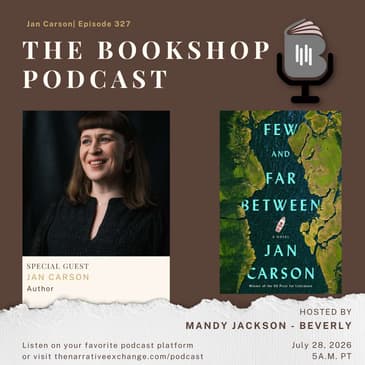
A plan to drain a lake sounds like a punchline until you remember it was real. In this episode, I’m joined by Belfast novelist Jan Carson to talk about Few And Far Between, her brilliant alternative history that asks what might have happened if a Northern Irish politician had actually tried to reshape Loch Neagh and “solve” unemployment and conflict with one giant engineering fantasy. From that single archival spark, Jan builds an archipelago, a would-be utopia, and a home that’s about to disappear again.
We get into why Loch Neagh functions like a character and a warning. Jan connects the story’s blue-green algae crisis to the real environmental disaster unfolding on the loch today, and we discuss the messy triangle of farmers, politicians, and environmental campaigners, plus the uncomfortable question of who is expected to pay for cleanup. The conversation also moves into the novel’s deeper currents: toxic masculinity, generational trauma, and what Northern Ireland tries to submerge when moving on feels easier than facing what happened.
Jan talks about writing parables without turning fiction into a lecture, grounding magical realism so it feels emotionally true, and structuring a book with multiple timelines plus a textbook thread packed with footnotes. She shares what 29 rewrites taught her about editing and what it was like recording the audiobook when footnotes refuse to behave.
If you love literary fiction, climate fiction, Irish literature, and authors discussing the highs and lows of their writing process, this one is for you.
Subscribe, share the episode with a fellow reader, and leave a review wherever you listen.
Host Update And Live Events
SPEAKER_00I'm Lady Jackson Berkeley, the founder of the Narrative Exchange, featuring the bookshop. Lunch with the most literary series in Southern California, writing workshops and the narrative exchange books. Here is the bookshop. It's all the world through conversations with authors, independent bookshop owners, booksellers, and publishing professionals who keep literature alive. If you enjoy the show, please subscribe, share it, and leave a review wherever you listen. You're listening to episode 327. Hi everyone. As I wind down the in-person literary series for August, I'm taking time off to welcome my second grandchild into the world. I'll be in Ireland for most of August and intend giving a new granddaughter as much love as I'm able during this time and cook and pamper her parents. The Lunch with an Author Literary series is back in September with an added brand new Los Angeles venue and partnership, which I am super excited about. Viva Gallery is owned and run by the Anderson family, and it's featured exhibitions such as Monumental by Andy Scott, the art of surf, an homage to Southern California's surf and skate culture, and Veiled Resonance, a solo exhibition by Chinese master artist Chung Sua, to name a few. This partnership with FIFA Gallery is called Entre Nou, which is French Ball Between Us and will mirror my Santa Barbara and OHI literary lunches, bringing acclaimed authors, engaging conversation, and exceptional cuisine, with the added bonus of being surrounded by contemporary art at FIFA Gallery. Our first author guest is the acclaimed writer Tess Gerritson, in conversation with me about her latest novel, The Shadow Friends. Tess will also be my guest in Ohio at Magic Hour, followed by the Santa Barbara Luncheon at the University Club with California's author sweetheart, Lisa C. A sincere thank you to my partners, Magic Hour, the University Club in Santa Barbara, and VIFA Gallery, who, like me, believe in gathering communities together to converse about books, reading, creativity, and enjoying food together. For more information and to purchase tickets, please go to thenarrativeexchange.com and click on events. Okay, let's get on with today's episode.
Introducing Jan Carson And The Novel
SPEAKER_00And I am excited about this conversation as it's with one of my favorite authors, whom I get to call my friend Jan Carson. Jan has been on the show a few times, and we spoke in person in Santa Barbara and OHI a couple of years ago. In November, Jen and her friend author Lucy Caldwell will be my guests in Los Angeles, Oi, and Santa Barbara. Don't miss these two fabulous writers in conversation. Get your tickets now at thenarrativeexchange.com and click on events. Now here's a little bit about Jen. Jen Carson is the author of several short story collections and novels, including Quickly While I Still Have Horses, The Raptors, and The Firestarters, which was winner of the EU Prize for Literature. She has won the Harper's Bazaar short story competition and been shortlisted for many awards, including the BBC National Short Story Award, the Sean O'Fhelan Short Story Prize, and the Irish Book Awards novel of the year. Jan is a fellow of the Royal Society of Literature, and her writing has been translated into over a dozen languages, appeared in numerous journals, and been frequently broadcast on BBC Radio. She lives in Belfast, and her latest novel is titled Few and Far Between. And it is brilliant. It's a must-read for me. Here's a short synopsis of Few and Far Between. In 1958, a politician's ludicrous proposal to create a seventh county for Northern Ireland by draining Lochney, the largest lake in Ireland, was, quite understandably, never implemented. In Few and Far Between, Jan Carson imagines a timeline in which the scheme proceeded. When an archipelago emerges from the receding water, a utopian community establishes itself on the islands, hoping to escape the prejudices and dangers of Trouble's Era Northern Ireland. Hi Jan and welcome to the show. It's so good to have you here again. Thanks. It's lovely to be with you again. You know I adore your writing, and I've got to tell you, Few and Far Between is one of the best books I have read in a long time. It is funny, it's sensitive, the magical realism touches my heart, the story was just fabulous, and I absolutely adore your characters. All I can say is congratulations, you've written a fantastic book.
The Newspaper Article That Lit It
SPEAKER_00Thank you. Thank you for writing such a great novel. Um, I remember a few years ago when you were in California. I can't remember if it was like two or three years ago.
SPEAKER_01I think it'd be two years in September time, I think. Yeah, so coming up on two years, yeah.
SPEAKER_00Yeah, that sounds right. But you were telling me about the topic of this book, Few and Far Between. How did the story of Terence O'Neill's proposed draining of Lochnay land in your orbit?
SPEAKER_01Yeah, so um I oftentimes people ask you where do novels come from, and it's the the great hundred dollar question because I never really know, but with this one I do specifically know. So I was stuck in a really dull residency in a very dull city in eastern France for four months, and the writing was not common. That happens to me quite a lot on residencies. And a friend sent me this incredible newspaper article about Terence O'Neill, who later became the last prime minister of Northern Ireland before the Troubles, but back in 1958, he was the finance
Terence O’Neill And The Big Schemes
SPEAKER_01minister and he was kind of known for his crazy schemes. It'd be fair to say Terence O'Neill was a bit of a character, and um, one of his crazy schemes in this newspaper article was that he would drain Loch Ne. And for those of you who don't know, if you picture kind of Ireland, Loch Neigh is the big lake right in the middle of the north at the top. So it's like a big eye. Um, and it's the largest, largest freshwater lake in the UK and Ireland. He wanted it to drain this and to combat problems with unemployment and turn it into the seventh county of Northern Ireland and build a commuter village right in the middle of it. And I just thought, what a fantastic story. I'm gonna write an alternative history where he took a run at trying to drain the loch.
SPEAKER_00It's such a brilliant story. You know, I went down one rabbit hole while I was reading the book and punched in uh what's the stupidest thing Terence O'Neill ever did or thought about doing? Draining Lochnay was right up there.
SPEAKER_01Did you did you hear about Ulster 71? Did that come up in the movie throughout?
SPEAKER_00I think that was second after the draining of Lochnay.
SPEAKER_01I feel there's going to be a follow-up Terence O'Neill book with all of the daft things that he proposed, but in 1971, and that would have been the 50th anniversary of partition, so the North being annexed onto the rest of the UK, um, he came up with the idea of having a giant tourism exhibition for three months in Belfast to encourage visitors to come and visit Northern Ireland. Now, if you know anything about your history, 1971 was two years into the conflict. So really it didn't put Northern Ireland on the map as a tourist destination. And there's amazing footage of our one of our local newscasters, you know, broadcasting live from the tourist exhibition as army guys with guns walk past in the background.
SPEAKER_00Oh my goodness.
SPEAKER_01You know what? A third of the entire population of Northern Ireland went to visit the exhibition, so it was very popular with local people. It just didn't attract tourism.
SPEAKER_00No. Well what led you to turn O'Neill's idea onto its head and instead flood the lake?
Why Flooding Beats Draining The Loch
SPEAKER_01So I began to do a bit of Googling, and I'd like to say that I'm a very careful researcher as an author, but mostly I just go on Wikipedia and Google stuff. And so I popped into Google, could you drain Lochney? And very quickly realized you couldn't drain it because um, well, you could take all the water out, but it rains a lot in Northern Ireland, which you've been to Ireland, Mandy, you know this.
SPEAKER_00Yeah, I mean it's green for a reason, right?
SPEAKER_01And it all of the the whole land is sloped down to Lochney, so it would just fill up again. But I did very interestingly discover there's an archipelago of little pieces of raised land right in the middle of Lochney, and these are real. So if you were able to drop the waterline a little bit, these this archipelago of islands would appear, and they had the most evocative, interesting names like Eglish Flat and Whitehorse Flat and Tom's Hard, and instantly all of my kind of creative energy just was popping all over the place. And I asked myself a big question early on, you know, who would live on these islands? And the troubles began proper in 1969, and I thought, you know, it wouldn't be beyond the realms of reason that maybe some people who didn't feel safe in Northern Ireland might seek kind of solace out on these islands, and from that very quickly came this idea of a kind of utopian community trying to form on Big Flat, which is the largest of the islands out there, and
Big Flat Utopia Meets 2017 Crisis
SPEAKER_01that became my community. Um, the story that you follow in the novel is mostly set in 2017, and we currently have this is real life, we currently have a really bad blue-green algae outbreak in Lochnow, so it's an ecological disaster. Um, and the novel is fixed on Marion and Robert John Connolly, who are the two grown-up children of the anthropologist who came out in the 70s to record this utopian community. They still live on the island, they're in their like mid-50s, which I stress is not old at all. So I I refuse to call them older people, but they have been living in a weird island situation for 50 years, and the government are about to flood Lochnow to try and get rid of this algae, sweep it up the river and out to sea. So poor Marion and Robert Dawn are gonna lose their homes and have to move back to kind of contemporary society and modernity for the first time in 50 years.
SPEAKER_00In your book, you cover so much, and you bring in many layers: the environmental layer, uh, the relationships uh between all of the cast members, I'll call them, the characters. And and the word toxicity covers many different aspects in the book, including toxic masculinity. But
Loch Neagh As Metaphor And Witness
SPEAKER_00I do want to talk about your essay about Few and Far Between for the Irish Examiner. You explain that in your novel, quote, Lochne serves as an extended metaphor for a number of issues endemic in this part of the world, not least the inability to recognize the enormous potential of what is right in front of us, end quote. Lochne seems to function as more than setting, almost as a witness, a warning and metaphor. When did you realize it carried that symbolic weight in the book? Or was it something that you originally strode for?
SPEAKER_01I think I love working and extended metaphors, and it became really apparent quite close or quite early in the writing process that this novel was going to be about three big things: an ecological crisis, toxic masculinity, and this idea of how we've dealt with trauma in the past in Northern Ireland. And you know, we often try to submerge it and hope it'll go away or bury it, and inevitably it kind of rises to the surface again. And when you I thought about all of those things, the loch just felt like such a good metaphor for them. Um, it's an angry piece of water. You know, if you go to see it on a good day, like today it's beautiful today in Northern Ireland, the sky is blue and the loch will be stunning, but mostly it's impossible to see where the grey sky ends and the grey water starts. It's a very it's quite an angry masculine space. Um, and it's also a space, as I mentioned in that article, that a lot of people find inaccessible. So we're a very small country, 1.7 million people. And um, as I've been going around with this book, I've asked folks about their relationship with the loch, and about a third of folks I've talked to have never been to it. And yet it takes up about I think it's an eleventh of the entire land mass of the country. But you'll meet people in their 60s and 70s who've never been there, and some of that is because it's not an easy um area of outstanding beauty, you have to work at it, it's quite ugly, it's um in places very physically inaccessible, you know, there's not a path around the edge of it. Um and and that to me feels very, very similar to who we are as a people. It's such an important space in terms of it's you know, it's it's home to a number of really rare bird species, it's a wetland of um outstanding international significance. Most of our water in the north, the water cycle is linked to it, the coming and placing of water, and yet we don't really appreciate it. And I think we're like that a little bit as a people sometimes. You know, we're very stoic, we're very um kind of just keep going, and like we don't allow ourselves to to be as joyful sometimes and to be as celebratory as we should be. So I think I felt like with the loch, there was just so much in there to unpick and that it was all wind up together, all of the concepts and and um
Algae, Farmers, Politics And Ownership
SPEAKER_01ideas about what I wanted to write about.
SPEAKER_00We have seasons of blue-green algae here along the coast in California, and many scientists say it is caused by toxic chemicals that are used in farming that come down from the hills and the mountains into the ocean. Which is the same at the last, yeah. However, when I looked at photos uh from social media, from science magazines, uh just randomly on the internet, Lognay is green and blue. One lady said it looks like hardened paint splatters, and that's exactly what it looks like.
SPEAKER_01We actually, I don't know if you noticed, but but we the cover of the MUS version of the novel was actually based, the artist was looking at cell samples of what the algae looks like close up under a microscope. So some of the texture of it is based on the kind of cellular color of what the algae looks like. Um it's a super, super complex conversation, man. I like um here in the north, and it's maybe the same in California, um, there's been a lot of kind of tension between the politicians, the environmentalists, and the farmers. The reality here, and I would imagine it's the same in the states, is um back in the 50s, the farmers here were told to up their productivity, and they were back then given bad guidance about up your productivity using all of these chemicals and things that at the time they didn't realise were so dangerous, and so now they're being portrayed as the villains in the the whole story because it's the effluent that's run off the land that has poisoned the loch. But they're also a bit like, well, we just did what we were told to do, we follow the guidance. Um, so a lot of the work has been um, and there's some really good work going on from the ecological campaigners, but also through things like there's an organization called the Loch Nye Partnership who are working with the farmers to try and help them introduce small manageable measures that will have like a big impact on things like control in the effluent that comes off the farms. Um, and then we have a third question in the mix that maybe you don't have in California, in that the actual loch bed of Lochney is still owned by um like land at Gentry. So it's a throwback to kind of the colonial times when an English family came and took ownership of the loch. So he is currently refusing to take any responsibility for the environmental cleanup. So there's a whole colonial story thrown in here as well.
SPEAKER_00It's a little crazy to think that one family owns this whole area.
SPEAKER_02Yeah.
SPEAKER_00I still like to think and hope that at some stage the politicians will start reading scientific literature and understand that the planet is in chaos environmentally, and we need to do something about it. I mean, here in the States we have a lunatic running the country and it is scary, especially environmentally.
SPEAKER_01One of the really nice things about the book, and I don't profess to be any any way an expert on the ecology of it, but I've had messages from some of the environmental campaigners that are involved, and they've said it's really helped to get the lock back into the the sightlines of the kind of people that would be on the edge of the conversation that would be concerned but not actively concerned. So it really is starting to help foster a relationship between folks who didn't have a previous relationship with the LORC and and um you know, maybe going and taking a walk and actually looking at it or finding out a bit more about the algae outbreak. So that's been really positive to hear that.
SPEAKER_00Oh, I would love to see Few and Far Between as part of the curriculum in schools, in high schools, all over the world. That's how important I think this book is. I would too, yes. In the quote I read earlier, there's that one little phrase that says, quote, right in front of us, end quote. But it feels both political and intimate. Were you thinking more about place, people, history repeating itself, or imagination when writing these words?
SPEAKER_01I guess I mean
Writing Parables Without Preaching
SPEAKER_01I'm always thinking about all of those things in a kind of big mixy messy model with each other. I'm not sure if we've talked about this before, but I would see myself very much as a writer of parables. And there's an idea that I I am not a writer who doesn't want there to be messages buried in my work. I like to start with I want to talk about these three things. Um I think the danger then is that sometimes that can make for a very preachy, earnest piece of writing. Um, I've been using this a lot latently because I just love it so much. Fona Groark is our current chair of Ireland Poetry, and she's a wonderful poet and a great speaker. And I heard her give a lecture a few weeks ago about um how Seamus Haney uses message in his work, and she said, you know, Haney was a poet that that his poems were always about something, but the aboutness of them wasn't too close to the surface.
SPEAKER_00Oh yeah, that's beautiful.
SPEAKER_01And I've been thinking about that a lot that the aboutness of your work can't be too close to the surface, it has to be um hidden within well-drawn characters and a story that the readers want to engage in and metaphors that are specious enough for them to unpick and work out for themselves, or it just reads like, here is what I want you to think, and I'm gonna shove it down your throat. Um, nobody likes to be patronized by a book. Well, I don't anyway.
SPEAKER_00Yeah, I'm with you there. And that's why we have nonfiction. I think one of the beautiful things about this book and your writing is I must say I got through the book, and the parts of the book were that were uh magical realism seemed real to me. Uh, and that's the beauty of fiction, I guess. With good writing, one gets lost in a story and it becomes real. And that's not always easy to do.
SPEAKER_01And I wanted I wanted to blur the line here with this book between what is real and and what's not, and and that that's done for a number of reasons and in a number of ways. So there's an actual textbook that runs through the the novel, it explains some of the more technical parts of the history and geography, and it has footnotes um citing uh fake like academic papers and things, and so many people googling to find where where can I get my hands on this this like piece of paper about the peace process or whatever. Um so I want it to play with that of of pushing readers to question what's real and what's not, because the north is this strange liminal space where oftentimes the things that are real are so absurd you could almost be mistaken for thinking no, that's made up and the opposite way around as well. Sometimes um, you know, the people will believe and buy into these absolutely
The Far Side Islands And Hidden Grief
SPEAKER_01ludicrous notions and conspiracy theories and weird things. So um one of the the the I think the most troubling things I've heard from this novel is um there's a one of the islands, there's there's two sets of the islands in the book, the kind of islands that the humans live on, and a kind of cluster of almost haunted islands called the far side. And they're referred to in the book as the dumping ground for everything. That people didn't want to deal with after the troubles. And there's an island there called Tom's Hard, which is based on the Japanese suicide forest Ayogahara, and it's where people can go to conveniently take their own life. And it I wanted that in there because we have a huge problem with suicide in Northern Ireland. And I actually have um heard from a couple of journalists outside Ireland that they believed that a man was going to drain Lochney with a series of mop buckets, but they queried my suicide statistics. They thought I'd made up the five and a half thousand people who've taken their own lives in the last 27 years. And there's something in that that's really interesting about what we choose to believe and what we choose to kind of pretend isn't real and look the other way from. So I was thinking about that a lot, and I then I also um I wanted the the magical realism elements to this novel to feel really grounded in kind of I guess the aboutness of the points I wanted to get across. So the two islands that are most magical are Eglish Flat, which eats things, it's like a carnivorous island, and it's been a dumping ground for guns and um hard drives and even body parts over the years, and it's now started to spit everything back up again. And to me, you don't need any kind of like ability to unpick metaphor to see that that's about burying trauma and how it also always resurfaces. And then there's also an island of almost deads, which are people stuck in a kind of limbo between life and death, and that for me was thinking a lot about the kind of limbo and the stasis that we are in as a community at the minute, and I think it's particularly pertinent in Northern Ireland, we haven't moved forward as fast as we should have, but I think it's a moment in the world as well at the minute. It feels like a limbo time, um fearful about what's going to come next. And you're yeah, and and that felt like a very pertinent metaphor. The fourth and final island in the far side is um middle flat. And middle flat is where, and I'm not sure if you if people think these are magical realism or not, but there's a group of women called the sleepers who who live there, and they are permanently asleep because they've um been through a kind of traumatic experience, and that's real, like that's an actual like medical syndrome that's been documented in a lot of places around the world where people get um out of a kind of conflict-threatening space and their body just goes into shutdown. So I was thinking a lot with the far side of two of those islands are out and out magical, and two are real, but almost at the end of the possible in this kind of weird, absurd space. And I thought a lot about the thing that Margaret Atwood said when she was um writing The Handmaid's Tale. That do you know what? There's nothing in this book that hasn't happened to women somewhere in the world. I've just pulled it all together. So all of those islands feel like I've I've pulled different things together, but they're not beyond the realms of possibility to be to be kind of pertinent to Northern Ireland and what happened there.
SPEAKER_00I became super emotional reading about the sleepers and how they were just shoved out on this island, hidden away from the rest of the world, you know, because God forbid if anybody saw them.
SPEAKER_01Yeah, I mean it's not it's not unlike putting something on an island and hoping it just disappears. Um, they're another version of a kind of island that eats things. Um I think and I get I guess this is a story that's repeated all over the world in conflict situations, but I specifically have made them mostly women because I I think oftentimes in conflict situations um women bear a lot of the brunt of the trauma and they just keep going and they, you know, that's what we're good at as women, like holding the family together, and and as soon as you get to a point where you feel safe, your body just goes and falls apart.
SPEAKER_00Yeah, and that whole part had me thinking about inherited trauma because unless someone in a generation stops and thinks about where this is coming from, uh and says, Okay, I'm gonna try and stop it now, then it's like a dust devil just keeps
Twenty-Nine Rewrites And Earned Hope
SPEAKER_00building and building and building until it's so big you can't stop it.
SPEAKER_01Yeah, I mean, definitely there is that sense, and it's really funny because everyone keeps saying, you know, how this book flows really well, and they, you know, it's it's so like intricately put together. And for me, this was the clunkiest, most difficult novel that I've ever written, and it took 29 full rewrites to get it to this stage. And one of the things that I changed in it was all of the main characters had a kind of hopeless end in the original versions, and I spent so much time with them and I grew to love them. And I also was thinking about my readers because you cannot give a naively optimistic end to the questions about climate issues in this novel, equally with the kind of generational trauma and kind of the legacy of the troubles, it would be really kind of saggarin to be like, and then a rainbow appeared and everything was fine, and they cleaned up the loch. So I need it to give people some degree of hope. Um the hope for me in all of those big questions is always people. You know, I said at my book launch that I've written the same book for the ninth time, and the strap line of it is aren't people terrible and also wonderful? Yeah, that's so true. The hope for things like generational trauma is that people are so much more resilient and kind and generous and tenacious than they should be, and so despite all of the you know things that we should be seeing, we often see these kind of like healing flourishing and like reconciliation flourishing, and it's the people have every right to be traumatized and angry and hurt for the rest of their life, and I see it every day in Belfast that they're choosing not to be that. Um, so I think I think it's people for me. I always come back to my hope is in community and people.
SPEAKER_00And you practice that every single day, Jane. I mean, you're one of the kindest people I know. You are extremely supportive of other writers, and you love to work within your community to help and encourage others to write. Okay, let's talk about the Connolly family. Father, Mutter, Rosemary, Robert John, and Marion begin work life, meaning life on an archipelago, in 1972. At the jetty, when they're about to board a small boat for the island that will be their home, father tells his family, quote, remember, we're here to observe, not make friends. We're first and foremost the anthropologist, end quote. I couldn't help but think that father uses the term anthropology to dismiss his shameless behavior in the name of science. And I don't want to give away too much. Um, because a blue-green algae matches the toxic masculinity of father.
SPEAKER_01I I think that um RJ, that's the name of the father. Um it's very confusing because in Northern Ireland lots of men are current called after their father and their grandfather and their great-grandfather. So RJ Connolly's son is Robert John, and that's how they they differentiate between the two. I think RJ sees himself in this the anthropologist's role as it's almost the way a zoekeeper would look at animals. Like he sets himself above the the people that you know he would see as his subjects. You know, very quickly he goes from being this um removed kind of objective figure, just observing people, to like he talks about himself as like the high king and the prophet, and people look to him for you know what should we do about this? And um I I was super interested in the relationship between um Robert John and and RJ, his father, and like to be very honest, everyone loves Marion in this book. Robert John is my absolute favourite, and I probably one of my favourite characters I've ever written because he's we meet him when he's in his late 50s, and he's the product of having a father who everybody has on a pedestal. Like RJ, like he could be in the Epstein Files. He is one of those men as he literally has a library named after him, and everyone thinks he's amazing. And Robert John's watching that really closely and going, Oh, that must be what it means to be a man, but he's also seeing his daddy at home in real life and how he treats his mother and how he treats him and how he's dismissive of people, and he can't reconcile the two things because he knows inherently that's not a nice way to treat people. But my father has been valorized for this, and I'm again I don't know what's going on in the US, but here we've had an incredible amount of art dealing with toxic masculinity in young men, um, you know, teenage boys and the influence of the internet and um influencers and things like that. Not so much on what happens if you've been wrestling with ideas of what it means to be a man your entire life, and particularly Robert John's in this kind of isolated, removed situation where he's not had that many models of good masculinity around him. So, to me, as a character, he was super interesting to write because he's pretty heinous at the start of the novel, and I just wanted to see if I could take readers on a journey with him where they could, if not, feel more sympathetic to him by the end, at least understand why he is the way he is. And I just I I love him to bits and I love all of his weak weird quirks, like he has a real junk food fetish, but he sees himself as an intellectual, so he can't be caught eating chunky Kit Kats or like bad food. Yeah, that was really, really funny in the book.
SPEAKER_00Is there a part of the book you'd like to read to us, Jan?
Marion Discovers The Internet
SPEAKER_01Yeah, so I was gonna read a couple of pages of Marion because we haven't really talked about Pearl of Marion.
SPEAKER_00Yes, I think that would be great. We can introduce everyone to Marion.
SPEAKER_01Uh so Marion is Robert John's younger sister, so she's the youngest of the three Connolly siblings. Uh, her and Robert John are still living in the family home, though their parents have passed on. Their sister Rosemary has moved to the mainland. Um, Marion, at as we meet her in the novel, has just discovered the internet for the first time. She got a um a kind of contraband mobile phone as a Christmas present, and she spends a lot of time online comparing herself to other women because she's been isolated for quite a long time and is now with the flood about to be forced to move back to kind of the real world. So I'm gonna read you two pages from Marion and the internet. When she isn't keeping the house ticking over, Marion spends hours online. She lies on her bed in the closed curtain fog and scrolls and scrolls until her thumb feels bruised. She does not post or comment. Marion prefers to lurk. She watches pre-recorded talks. A woman who started a company and raised three children and fought breast cancer all by herself, no husband in sight. This woman speaks without notes for half an hour. Marion cannot fathom how she remembers it all. She watches a makeup tutorial. With the right sort of blusher, you can achieve pronounced cheekbones, even if your face is fat. She reads an article about women marching for women's rights. She joins an online book group discussing the writer Donna Tarte. Marion doesn't contribute. She's never heard of Donna Tarte. She scrolls through pictures of famous women all dolled up for the Oscars. Big hair, big dresses, big cow eyes. Marion knows what the Oscars are. She's not complete Philistine. It is hard for Marion to look at these women and see anything of herself. She's a hag in comparison. She might only be fifty-three, and fifty-three's not old these days. But island life has weathered her. Sometimes she looks in the mirror and sees an old woman frowning back. Robert John's a very same. They've grown old before their time. Still, Marion loves the internet. Every so often she'll stumble upon an interesting man, but it's always the woman to whom she returns. Mostly mummy bloggers. Marion adores a mummy blogger. They're so self righteous, so adamant. She feels part of their conversation, laughing along, occasionally tutting in sympathy, and she's learning all the time. She knows things she didn't know last year, such as how to tell if you're an aimic, and what a Kardashian is, and why you shouldn't wear vertical stripes or feed a child uncut grapes. She tells herself this is why I am online. I am becoming better informed. Marianne knows this is bullshit. She's happy enough to think the word bullshit, though it's not a word she'd ever say. She knows she's addicted to the internet. She wishes Rosemary had not given her a mobile for Christmas. She'd specifically said don't be buying me a mobile phone, knowing her brother would not approve. A pair of slippers would have been more suitable, or another Merry Berry begging book. But Rosemary had insisted. She said it was downright dangerous. Two old folk living alone on an island with no means of calling for help. What about burglars and heart attacks? What if Robert John took a mad turn and went at you with a carvin knife? Marion said they'd the CB radio for emergencies. She did not require a mobile phone. Rosemary, been Rosemary, ignored her. And on Christmas morning presented Marion with a smartphone, gift wrapped in a giant box so Robert John wouldn't know what it was. Marion regrets the hours she's wasted online. She could have made a start on the hot press, or pickled the excess of sweet tomatoes which will otherwise end up binned. She could have been knitting the footery part of Sandra's birthday cardigan, the yoke with its tricky pattern of fleur de lae. All these tasks are real and pressing, the sort of small, attainable goals with which she previously filled her days. Now Marian's head is constantly buzzing with internet women, every one of them brave and groundbreaking, dancing away like nobody's watching, not caring how lumpy they look in their tight, stretchy clothes, living their big, loud lives online. Marian can't help but hold her own life up in comparison. It's like a jumper that used to fit before she put on a power away it.
SPEAKER_00Brilliant. Thank you, Jen. Did you write that section early on in the writing process of the manuscript? Or did you
Three Strands Plus A Fake Textbook
SPEAKER_00write the story in sequence? How was it?
SPEAKER_01Well, Mandy, thanks for taking me back to PTSD. I so I started this book four years ago and it bears absolutely no resemblance to what I started with. Um the first big upset was about 18 months in, maybe less, about a year in the blue-green algae outbreak started. So there was none of that in the first draft. And then I thought I can't write a book about Loch now without this, it is such an important issue. So I had to rewrite with the blue-green algae in it. Um and then um the just the structural stuff, because there are three narratives through it: the textbook, the kind of present-day narrative, and then a strand that goes back to 1958 and takes you through the history. Um, it end up literally printing the whole thing out and then cutting it up with scissors and moving it around. And um, I've had two really good editors, um, Kirsty Dunsaith at at Penguin and um Emily Polson at Scribner, who were co-editing on it. And I think they put in an enormous amount of work, so it's partly a credit to them that it has all come together. But if you'd asked me this question exactly this time last year, I was pulling my hair out and saying things like, I think it's a Frankenstein's monster of a book.
SPEAKER_00And yet it reads as smooth as glass. And let's face it, editors are pretty magic, can't they?
SPEAKER_01They are, and I I think it's just it's something that I like to talk about a lot. That um there's a kind of preconception sometimes with writers who've not published before that you know, maybe you do two drafts or three drafts, and like I know from my friends and myself, my own experience, that it's much more likely to be maybe you do 24 drafts or 30 drafts, and that there's a a certain amount of kind of energy that comes close to the start of a novel where you're fresh with the characters and the ideas, but there is a huge amount of creativity that comes in the edit. It's it's maybe not as sexy and fun, but that is really where the kind of hard work of a novel comes in.
SPEAKER_00Um yeah, it's kind of like the logical part of getting the whole manuscript together. Uh, you know, as writers, we're so entrenched in the story and deep in the darkness of trying to figure everything out. I I think it's so comforting to have editors. Did you decide early on in your writing that you would bring the um work written by Alex, the scientific work, into the story?
SPEAKER_01Um, I think that that um was uh I think an editorial note quite early on that we needed some way to drop some of the information in. So uh all of my work, apart from my first novel, is about Northern Ireland, and I feel very lucky that it has been translated and it's been published worldwide, but you'd never assume that a reader is going to know some of the stuff that we kind of inherently know living here. So I've used lots of different techniques to get that across. Like in the raptures, there's a child who asks a lot of very searching questions, and that allows me to explain the politics and things. Um, here just felt like there was too much kind of actual physical geographical information, um, and so it seemed quite obvious to me that we needed something like a non-fiction type thing, but I didn't want a straight nonfiction, um, or it would be quite dull. And so one of the fun things was trying to find the voice of the textbook part. So Alex is an academic, but she's an academic who, as a child, grew up in the community on Big Flat, and she herself has a kind of complex relationship with the law. So you often get um kind of the official line in the body of the text in the textbook, and then Alex has got little asides in the footnotes where more of her voice is starting to lick into it.
SPEAKER_00The footnotes are fantastic. I couldn't help but think, my god, this is like writing another book.
SPEAKER_01Well, I will say this to anybody who's listened to
Recording Footnotes For The Audiobook
SPEAKER_01this. I did the the audiobook of this one myself, and I don't know how anyone is meant to do footnotes in an in an audiobook. We, you know, one of my favourite texts is um Labakoff's Pale Fire, and it's almost entirely footnotes. There's as many footnotes as the body of the text, and if he did his own audiobook, he would have just been screwed. You end up trying to think things like do I change my voice when it goes to footnote? Do they have a little bell I ring? Um, so there was a lot of experimenting with how do we do footnotes in an audiobook. How long did it take you to narrate the audiobook? Um so apparently, and this is a little bit worrying, I did the audiobook for this one, and I did the audiobook for the raptures, um, both with like about a month between them. So they had me in the studio for a week, but I got it done in three days. And um about the second half the end of the second day, they said this is the point that most people's voices start to go. And I was like, nope, mine's fine, mine's grand. And you must talk a lot in real life.
SPEAKER_00Oh my goodness, I can't believe you did that in three days.
SPEAKER_01Like you know all about recording, and like you've got a man in your house that's got like a studio at the bottom of your garden. And I think again, some of the stuff with that was just the the professionalism of having a producer in the like not in the sound booth with you, but next to you to coach you through pronunciation and um where you bring emotion and energy into your voice. I'm not a professional actor, but I write for my own voice. And so I know how I want it to sound in my head.
SPEAKER_00And you've done a lot of work with the BBC, right? I mean, that's good training, that's solid training.
SPEAKER_01Yeah, yeah. I but I've never recorded but well, I've done a few essays for Radio 4 that I've recorded myself, but when I'm writing fiction, it's always for an actor to write. And I'm actually I don't
Agatha Christie On BBC Radio
SPEAKER_01If I told you this or not, I'm um adapting an Agatha Christie at the minute.
SPEAKER_00You did. I mean, you're just doing everything. You are amazing, Jane.
SPEAKER_01I'm deep into that this week of um and we'll we'll be casting for it's a story about Agatha Christie rather than an adaptation of one of her stories. So I get to cast an Agatha Christie, which is very, very exciting.
SPEAKER_00And will this be a radio play through BBC or is it for theatre?
SPEAKER_01It's gonna be a radio play on Radio 4 in October. Some of your listeners, if you're they're in London, um, the British Library is has put on an enormous Christie retrospective, the biggest one ever, and it will run for almost a year from October. So there is a lot of kind of energy around Agatha Christie this year. Um so this is a part of a new season that is going out on Radio 4 in the BBC. Um the BBC have also just announced a new Puiro series, so they're going to um, you know, not just like a one-off, they're going to to recruit and we'll have a new kind of David Suchet kind of character um to record multiple Puiros. So um it's yeah, it's an exciting time to be an Agatha Christie fan. Yeah.
SPEAKER_00And not only are you a lover of anything, Agatha Christie, especially anything she wrote, I think I'd call you a bit of an Agatha Christie aficionado too.
SPEAKER_01Oh, well, I'm not I'm not an academic, and there's some wonderful academics working on her that are much more detailed than me, but I'm there's also a bunch of us who are professional full-time writers that owe her a great debt, and our relationship with her is more it is a little bit more fanatic, so I don't mind you saying that, man. But we you know when we get together, we nerd out like swapping. Did you know this? I didn't know did you know this? Um which is great, and I I I think one of the reasons I love being a Christie fan so much is it comes back to people, and she is a writer that pulls people from all different walks of life and ages and stages together. So I'm gonna be chatting to Sophie Hannah at our Belfast Book Festival in two weeks' time, who has rewritten or continued the Poirot kind of stories, and like her, like she's just all about bringing people into her work and you know, opening up Agatha Christie to another generation of readers, and we see that every time we do something with Agatha Christie, there'll be everybody from 13-year-olds to 80-year-olds, from literally Booker Prize winners to like folks that read a few Christie's whenever they were a kid. So to me, that's that's what literature should do. It should be you know, it should be well written, and I think there are quite a quite a lot of Christie's catalogue is well written. It's a bit flecky on the edges at the beginning and end of her career, but it should also be that thing that opens up conversations rather than locks people out and too snobby.
SPEAKER_00Yeah, when I ask authors which authors inspired them, Agatha Christie comes up a lot. I would say probably 85% of the time.
SPEAKER_01Yeah, no, I would love to do. Well, we'll see. I really love to in my head
The Myth Of Being Too Prolific
SPEAKER_01I have an essay collection about what Christie has taught me about being a writer, and it won't be on a sentence-by-sentence level, it'll be those big concepts, like for example, one of the things she got accused of, and I get frequently accused of is being too prolific. Like writing a lot of really good stuff is a bad thing. And I'd I would love to write into that space of our attitude to productivity, because it I think it's quite snobbish and it's also quite gendered often. Like nobody was taking Bob Dylan aside at you know, in the 60s and saying, Oh, you've just written these like six killer songs in one week. Like, what's what's wrong with you? You're too prolific. And it it doesn't understand creativity because you know it took me four years to write Few and Far Between, and during that period I wrote very little else. And then I finished that book about this time last year, and I've written two and a half novels, 11 short stories, and a stage play since then.
SPEAKER_00But I know next year I might write nothing like creativity ebbs and flows and work and as you said earlier, you were in France stuck trying to write whatever you were writing then, and all of a sudden you get um um some information from a friend, and your life turns around, your writing life turns around, and you start writing few and far between. One never knows when the um inspiration is going to hit you, but by God, you'd better be ready, right?
SPEAKER_01Absolutely. And just because it comes not to be too crude, but it comes thick and fast, it doesn't mean that it's it's bad, you know. For some people it will take them 15 years laboring over a novel because that's the kind of writer they are, and others, a really good novel will come out of them in six weeks. And like I'm not, I don't think we should be comparing and contrasting. You should just be like somebody's giving us a piece of good art in whatever form it came into the world, just be thankful for it and enjoy it.
SPEAKER_00Now, before we go, I want to ask you about your essay in agony.
A Story That Writes Like Visual Art
SPEAKER_00I thoroughly enjoyed it, but I started trying to look up the painting which you're talking about in the essay, and I have to ask you, was the painting real or was it from your imagination?
SPEAKER_01Uh no, so it's uh I was in the Czech Republic teaching last year and I um was having a really good conversation about literature that crosses form. So um, you know, can you write like it's a dance? Can you write like it's architecture? And I wanted to try and write like visual art. So this the story is called Um Domestic Scene with Suspended Child, and it's about a woman who was an you know had gone to art college to be an artist and for a number of reasons, mostly kind of domestic things. You know, she gets pregnant, she has a second child, she has a relationship that falls apart, her artistic career has been set aside, and we meet her at a moment where she's her child's um the remnants of her child's birthday party after that all of the toddlers have left and she's at the sink washing up, she looks out the window and she sees this kind of crazy scene that's happening outside. That her her youngest son has been thrown up in the air and he hasn't come down again. Um it's a quite a jan concept, but instead of letting the domestic part of her the mother of her take over, she experiences what happens next as an artist, so she's very descriptive of it, she's thinking about the composition, she's thinking about how she would move it slightly, bring in different lights and colours, and for a moment, this other part of her that isn't just tied to the domestic and being a mother gets to come out and play, and then she has to step through the kind of frame of it and actually rescue the child. And at that point, she starts thinking, you know, about nappies and feeding and all of this stuff, and the moment it's gone.
SPEAKER_00And thank you for sending me a copy of Agni. What a gift. Thank you.
SPEAKER_01So I got I got some I got four or free copies for friends in the States, and I was like, I sent Mandy a copy.
SPEAKER_00Well, it was much appreciated. Thank you. Do you happen to have a copy of the United States cover
Cover Details And Cultural Oddities
SPEAKER_00of the of Few and Far Between handy? Have a proof somewhere. I'm not sure. Oh, to the right side of the cover, uh on the edge of the lake, it looks like there's a a bull or maybe a dog watching over the lake. I don't know if you can see that or not.
SPEAKER_01It makes me just think of the kind of outline of Ireland, like that it's got these like kind of little cracks, and um and this is absolutely mad and not related to this at all, but I just have to tell you I was reading uh just back from a Scottish book tour, and I was reading in um uh a bookstore and talking about kind of the weird things that we do in Northern Ireland and uh Marion's love of avant-garde cooking in this book, and the lovely lady in the bookstore had made some Northern Irish cakes for everybody to sample, which is really nice. And there was a Scottish person there who said, Do you know that in Scotland women in the Women's Institute, which is kind of the like kind of do you know what the Women's Institute is, Madam Andy?
SPEAKER_00Not particularly, but I'm guessing it's similar to women's organization, women's auxiliary committees that we have here in the US. Social gathering of women.
SPEAKER_01It's not it's like this group that like you can join for in the old days, it was to learn how to be a better mother and wife, and they would have kind of competitions for sewing and baking. There must be an American it it it never goes on your whole life. You just join the women's institute and it meets once a month, and you can, you know, I essentially it's there for women to support each other, but it involves kind of crafting and baking and talking about how you darn your husband's socks and things. Um and then the Scottish Women's Institute they have competitions where um do you know what like a digestive biscuit is?
SPEAKER_00Of course I know what a digestive biscuit is. Chocolate digestive are my absolute favourite.
SPEAKER_01Women have to bite digestive biscuits into the shape of Scotland, so they use teeth to nibble, and then there are competitions for who's got the best likeness of Scotland in a digestive biscuit. Now, wouldn't you love to know who came up with that idea? Amazing. So I know it instantly I'm like, I have to go to one of these competitions because I really need to see this.
SPEAKER_00Good lord, they must go through packs of digestive.
SPEAKER_01Yeah, and I was like, what about the Shetlands and the Orkneys and all those wee islands? But I mean the bigger point in it is I am just fascinated by those strange little cultural things that are so specific to you know, when I go to America and I go to the Midwest, there are different customs there than you'll find. Like if you go down to Florida or you go to and here we have loads of our own weird things that we do, and they they make I think they make communities interesting, and there's been a misunderstanding sometimes in publishing that we should get, you know, we should make things bland and accessible. When actually I love it when I'm reading like an Elizabeth Strait and there's some kind of weird thing about New England, and I'm like, what the flip is that?
SPEAKER_00You know, that kind of brings me back to empathy and fiction because learning these stories of different cultures and different funny little islands around the world or communities, that's how we learn about each other.
SPEAKER_01It brings and it brings colour to a novel that you might learn something, even if you have to go and Google like Scottish digestive biscuit art or something.
SPEAKER_00I'm imagining that right now there's a lot of listeners who are actually Googling digestive art Scotland. But anyway, I do want to get back to the cover. I absolutely love it. It's beautiful.
SPEAKER_01I'm really pleased with the American cover. I think it it's it's possibly I I like this is the the this is a special listener, the Northern Irish one. It's nice and it's got very sexy end papers, which but the US one looks beautiful to me.
SPEAKER_00Yes, it
November Events And Final Thanks
SPEAKER_00certainly does. Okay, now let's uh talk about November because you are coming out to California for three of the literary luncheons that I hold, one in Los Angeles, one in Ojai, and one in Santa Barbara. Why don't you tell us who's coming out with you? Which author?
SPEAKER_01Um, I'm gonna come out with my pal Lissy Caldwell, who is um literally grew up round the corner for me, and she's the same year as me, same vintage. So Lucy and I get paired together all the time, which we are not complaining about. Um, she's literally the best short story writer in possibly the UK and Ireland. Uh, she's won the uh BBC National Short Story Prize, she has won the Walter Scott Um historical fiction prize for her last novel. Um, she's a playwright, she writes a lot for radio as well, and she's just a very generous, kind, and incredibly smart, much smarter than I am personally.
SPEAKER_00Well, you both write so differently, which is probably why you're so well paired together.
SPEAKER_01Yeah, I mean Lissy and I travel quite a bit together, and we shouldn't work on paper. Like I'm a bit sort of all over the place, and Lissy is so stylish and chic and very prepared, and it just works really, really well.
SPEAKER_00And we get to share your friendship and your stories in November in California. And I know you're going to be in uh on the East Coast as well. Jen, as usual, it's been great chatting with you. And I love Few and Far Between. It is just a fabulous read. And I'm excited about its US launch. Congratulations. It was worth every one of those 29 rewrites.
SPEAKER_01Thank you. I'm I'm starting to come around to that opinion. It's just taking me a wee while.
SPEAKER_00And I'm guessing you're exhausted.
SPEAKER_01Yeah, um, I think it was it it really drained like no pun intended, it really drained me like kind of crazy. But it was so weird. It was honestly like so. I wrote the next novel in six weeks after I finished this, and it just was like all of the ideas had been back here, just waiting to come out. So there was some I think this is the book that I grew up with as a writer that I learned that just because it's not working at the start, it doesn't mean that it's a bad idea, and you really need to persevere and wrestle with things sometimes. Um, and and also to like uh trust the process because at certain points in the edits it didn't look like it was working, but I have done this enough times now to know if I kept working at it and going back to my character profiles and stuff, it would come together. So it maybe has given me a bit more confidence as a a grown-up author to try more complicated difficult things.
SPEAKER_00It's fascinating to me hearing you speak about this because as a reader of your books, I would have to say the raptures, I'm surprised that that wasn't a complicated and emotional book for you to write too.
SPEAKER_01Yeah, they're deep, but they were they're more instinctively deep in that I was just telling the story as I it like I mean the raptures is very uh um autobiographical, so just telling it as it happened and letting the kind of natural metaphors and meaning kind of bubble up. Here it felt like I was working with a need to get the these all of these metaphors to line up. So the loch is a metaphor for the environment, is a metaphor for Northern Ireland, is it and yes, hope hopefully, hopefully it's worked. My big text that I always have on a pedestal is Salmon Rushdie's Midnight's Children, because it that's what it is doing. Everything is bound up in each other, um, and it's political, historical, funny, clever. Um, and you can't see the cracks as a reader, but I bet your bottom dollar that that took him an awfully long time to edit.
SPEAKER_00Well, congratulations on Few and Far Between. Like I said earlier, it's a fantastic book. Uh a great story, beautifully written, and um lots of love, and I can't wait to see you soon. All the best with the uh pub launch in the US. Thank you, Mandy. You've been listening to my conversation with Jan Collinson about her latest novel, Few and Far Between. Thank you for joining me on the Bookshop Podcast. This show is written and produced by me, Mandy Jackson Beverly, with music by Brian Beverly. My personal assistant is Kaylee Dishingen, and my graphic designer is Alexandra Mooney. If you enjoyed the episode, please follow, share, and leave a review wherever you listen. For more information, go to www.thenarrativeexchange.com. Until next time, here's to the books that shape us and the bookshops that bring us together.