
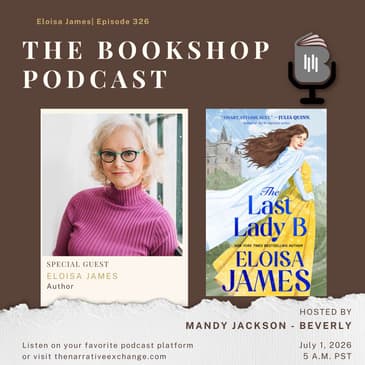
A haunted abbey in the Scottish Highlands, a marriage of convenience, a pet piglet with a ribbon, and a heroine who is far sharper than she’s “allowed” to be. In this episode, I chat with Eloisa James, the New York Times bestselling author of historical romance (and Fordham Shakespeare professor Mary Bly), to talk about The Last Lady B and the craft choices that make a love story feel witty, intimate, and impossible to put down.
We start with the roots of desire, including Eloisa’s childhood on a Minnesota farm in a house full of literature plus a long list of forbidden pleasures. That push-pull of wanting what you can’t have becomes a blueprint for romantic tension on the page. From there, we get practical about writing: why she studies TV and comedy scripts to master timing, how Shakespeare trains a writer to land a joke inside character, and why she drafts dialogue like a script so it reads the way people actually speak.
We also go deeper into what makes a romance scene truly charged, including the power of restraint, the emotional work behind “slow burn,” and why sensory details like fabric, lace, and the scent of a cravat can do more than paragraphs of explanation. Eloisa shares what it took to claim her romance career in academia, what she’s learned about genre bias, and why she believes you can’t write romance just to chase a payday.
Subscribe, share the episode with a fellow romance reader, and leave a review wherever you listen.
The Bookshop Podcast
Mandy Jackson-Beverly
Social Media Links
Welcome And Narrative Exchange Updates
SPEAKER_00Hi, I'm Mandy Jackson Beverly, founder of the Narrative Exchange. Featuring the Bookshop Podcast, the Lunch with an Author literary series in Southern California, writing workshops, and the Narrative Exchange Book Club. Here at the Bookshop Podcast, I explore the world of books through conversations with authors, independent bookshop owners, booksellers, and publishing professionals who keep literature alive. If you enjoy the show, please subscribe, share it, and leave a review wherever you listen. You're listening to episode 326. Well, hello to everyone. A quick update about the Narrative Exchange. If you've joined the Narrative Exchange Book Club, don't forget to log in to the new Members Lounge, which will be live this week. You'll find upcoming events, my thoughts on recent books I've read, a blog post telling you all about what's going on, and opportunities to chat with fellow members in the comments. And of course, you'll have access to our live Zoom conversations with authors. If you're an insider, creator, or founder member, please check your inbox because I've sent you a personal email with a few questions and would love to hear from you. This email will come from info at the narrativeexchange.com. Also, tickets are now available for the Lunch with an Author literary series events with Carrie Mayer in OHI and Santa Barbara in July. In September for Tess Gerrittson, only in Oi. And September we have Lisa C coming to Santa Barbara. Now if you're planning to attend Tess or Lisa's events, I encourage you to book early because both authors are appearing at just one luncheon. And I'm expecting both events to sell out quickly. To purchase your tickets, go to theNarrativeExchange.com and click on events. Okay, let's get on with this week's episode.
Meet Eloisa James And The Novel
SPEAKER_00Eloisa James is the New York Times and USA Today best-selling author of historical romance novels. Her books have been translated into 26 languages with sales worldwide of seven million. As Mary Bly, she is a Shakespeare professor at Fordham University. She lives in New York City and Florence, Italy. And you can find out more at EloisaJames.com. Here's a short synopsis of her latest novel, The Last Lady Bee, which I adored and absolutely recommend as an escape from the worries of the world. In the depths of winter, Lady Genevieve Burnsby, her pet piglet, and her septigenarian husband travel to a haunted abbey in the Scottish Highlands. Evie is excited to meet a ghost, perhaps one of her husband's three previous wives, but didn't expect the funny, quirky guests to become the friends she's never had. And she certainly didn't imagine meeting Sir Godric Everly, a sardonic, witty solicitor who loathes her husband. Yet, as secrets and lives turn Evie's world upside down, Sir Godric becomes the one person whom she can trust. Hi, Aloisa, also known as Mary Bly. Welcome to the show. It's great to have you here. Thank you so much for having me. You are welcome.
Farm Childhood And Forbidden Wanting
SPEAKER_00Now let's begin with learning about you and your earliest memories of being raised on a farm in Minnesota. What's a sensory memory from your childhood on that farm, something tactile, auditory, or visual that you feel still shows up in your writing today?
SPEAKER_01Hmm, that's a hard question. I will tell you one thing, which I was talking to my husband about last night. So my husband is from Italy, and he cannot understand marshmallows. He thinks they're disgusting, right? But I grew up on a farm and my parents were very um, you know, left-wing writers. My my dad was a poet, my mother was a short story writer. We were growing up without television and without white sugar. And so marshmallows were this like forbidden fruit that I adored. And and I still to this day, last night, I made myself ice cream with marshmallows on it. My husband was turning his nose up. And I think that the fact that I grew up in a in a household that loved literature so much, but also banned a lot of things. My mother was, you know, an early banner. Let's just say that. Cancellation was her middle name. And it all was like white sugar, this, that, you know, alter-processed food before she even knew that name. So what comes forward in my writing, I think one thing I do well is desire that for what you can't have, right? And it does come out in this book, too, because you know, my heroine is married to an elder gentleman, but she's married. She cannot have the grumpy solicitor she met in the courtyard. That's not on. So I think that just there were so many things I wanted. I wanted to watch TV, I wanted to eat marshmallows, I wanted to have ice cream, I wanted to move to New York and Paris. And I've done both of those things. And I eat a lot of marshmallows.
SPEAKER_00I love how you've related uh desire to food. That's really sweet. And apart from writing about desire really well, I would also say you write dialogue beautifully. It's absolutely divine. Um, but we'll go into that a little more later.
Elite Academia Versus Romance Writing
SPEAKER_00Uh, let's talk about your education. You gained a BA from Harvard, a master's in philosophy from Oxford, and a PhD in Renaissance Studies from Yale. Now, while each university represents different intellectual cultures, did any of them actively conflict with your instinct to write romance?
SPEAKER_01Well, one thing I should qualify is that Oxford, it wasn't a philosop philosophy degree. They just call it an MPhil. They have an M stud, which is one year, they have an MPhil, which is two years. So I had a two-year master's.
SPEAKER_00Well, thanks for that information. I appreciate it.
SPEAKER_01Um, did they actively clash? Absolutely. All three of them are at the very high end of the literary echelon, right? You are and I studied English literature at all three of them. And you are, it was preparing me for my career as a Shakespeare professor, even back at Harvard, even then. You know, I remember going to see Marge Garber, who's a very famous um Shakespeare professor now, but at the time was young, and watching her and thinking I could do that. So it was teaching me all those things. It had nothing to do with romance whatsoever, any of the three of them. What it did teach me though was there were a lot of intellectual people who actually really love romance. So, for example, when I went to Oxford, I had a roommate named Sauce, who is now the English professor in charge of the English department at Brazenos College, Oxford, which was one of the oldest and most august. And she and I decided to write romance. So we wrote a bunch of beginning romances about girls who dressed as boys, you know, so on and so on. She was an Oscar Wilde scholar. And that kept going. When I went to Yale, I made a friend who was totally into a genre I'd never heard of, which are these historicals that had sex in them. Historical romances with sex. She introduced me to that. She drove to the town next door. She didn't want to be seen in New Haven buying one of those. Oh my goodness.
SPEAKER_00You know, one thing though, I can't help but think that studying Shakespeare was kind of like a door opening to your humor. Because Shakespeare was witty. He wrote comedy, and uh there's just something, not come in comparison with your work, but there's definitely a little bit of flavor of Shakespeare to me in your humor. What are your thoughts on this?
Learning Humor Through Shakespeare And TV
SPEAKER_01I think that teaching Shakespeare, you know, every semester for years has taught me an enormous amount about dialogue, about how to make people laugh, about how to make a pun, how to create a pun that's actually part of the dialogue as opposed to just a one-word pun. But I will tell you that I also I'm ruthless in seeking out anybody who's funny. So, for example, right at the moment, I found in a secondhand store a version of uh not Are You Being Served, but Keeping Up Appearances. And it's incredibly funny, and the dialogue is brilliant. So we have brilliant screenwriters, are particularly people that I lean into and try to learn from.
SPEAKER_00Patricia Rutledge's delivery in keeping up appearances is just gorgeous in the TV series. I must say I'm a bit of a fan of Somerset Mom's work, and some of his pieces are so darn funny. The three fat ladies of Ontives come to mind. I I just adore that story. But you know, hearing you talk about keeping up appearances, I enjoy watching British and Irish TV series and movies. I mean, that they just brilliantly written, and I just think they're wonderful.
SPEAKER_01Yep, I will absolutely agree with you. They understand pauses, they understand how to carry a joke from one, you know, season to the next. I love I just learn so much from them. I tend to, if I can find a show that's genuinely funny, I'll go online and find the scripts that someone has laboriously written out and just read them again and again. Here's one of my favorites is right on the desk. So for those of you seeing, I'm holding up the Black Adder scripts because I have read this book. It's huge, like five times. It's everything because it is historical. I want to be historically accurate, more or less. But if I'm not funny, there's no point. I'm not writing scholarship here. It's not an information dump.
SPEAKER_00Yeah, one of my favorite Black Adder films, I think it was, was the uh Back and Forth, which is about time travel. There's one part in particular when uh Stephen Fry is a Roman general and he's wearing the extremely short military armor. Oh my goodness, that is so funny. I also am of the opinion that when comedy is well written, and I'm speaking about the English language here, it doesn't matter which English-speaking country the writer is from or where the story is set, well-written comedy delivers. It makes us laugh. And that's something I really enjoyed about The Last Lady B. You didn't write it for an American audience, and I think that's one of the beauties of the book. Um, was there ever a moment in your academic training where you felt you had to unlearn something to write emotionally direct fiction?
SPEAKER_01No. Because, you know, my academic training uh has gone hand in glove. I am an expert in body puns, written and performed in boys' plays. So Shakespeare was one of the very few, only two playwrights, didn't write for plays um for companies that were entirely made of boys, you know, boys playing the girls and boys playing the boys' parts. And those are very, very funny plays. So I'm an expert in sexual jokes. And so I can't say, you know, for me, what that did was make me look at a play, because if you don't understand the context of a joke, it doesn't pop. You don't know it. So I wrote a whole book on how important it is to actually know the context so that we can hear the laughter of people laughing in 1603. If we lose that laughter, we don't know what they thought was funny. Then we don't know anything about what they thought about sex, right?
SPEAKER_00Yes, absolutely. And and what's the name of the book that you wrote about puns?
SPEAKER_01My book is called Um Virgin Um Queen. Oh God, I haven't even thought of it so long. Um Virgin Queens. But it's Mary Bly, it's the only it's come out from Oxford, and yeah.
SPEAKER_00Oh, I'll have to grab a copy. Uh, let's talk about your parents, Robert and Carol Bly, because they were both writers. Now, did you initially resist becoming a writer because your parents were writers, or did it feel inevitable, or did they help you fall in love with the craft?
SPEAKER_01They did it would be the third. Um, the awkward thing for them and for me was that from the very from my earliest reading memories, I was interested in romance. And my mother was, you know, she loved Tolstoy. That's who she was reading when she was, she reread War and Peace when she was in the hospice, you know. And she said, Well, couldn't you just try to write like Tolstoy? But I didn't want to. I really love um romance and I really love humor. And so the things that I loved were not what they loved. So my parents split that way. My father really loved everything, and my stepmother read aloud the book that I don't uh that I uh, you know, donated, dedicated to him, you know, skipped all the sex parts, but she read the whole thing aloud. And my mother just referred to it as that sex stuff and wouldn't go anywhere near it. Last thing she said, one of the few last things she said to me was you're gonna write a real book in five years. So I wrote Paris in Love, which is my memoir of living in Paris for her. And it came out five years after she passed away. Because even when our parents want us to be something different, we're still so, so bound to want to please them. And so I did. I wanted to please her, and I still do, even though she's gone.
SPEAKER_00So yeah, I hear you and completely understand. I want to circle back to what you said earlier about desire, particularly in relation to Genevieve's dialogue, her letter writing and prose, there's kind of a youthfulness and a cheekiness in Genevieve's
Writing Dialogue Like A Script
SPEAKER_00dialogue. Do you hear your dialogue internally as you write, or does it only come alive in revision?
SPEAKER_01I hear it. I I I I write it like a script. That's one reason why I read so many scripts, is that if you if you're just typing, your sentences become very long, but that's not actually how people talk, and it's not how we actually want to read things either. So um yeah, I learned early on that if you start writing things that are coming into a block on the page, readers just skip over it.
SPEAKER_00You know, you're one of the only authors I've spoken with who says they read scripts. Now, to me, it's a no-brainer if you want to write. It's like I say to people, if you want to write, go and do an acting class, do some acting, and you'll understand pauses, you'll understand uh action and dialogue. Yep, and they're online. You could find them. Which is a great segue to my next question. How do you test whether a scene is working? Rhythm, pacing, emotional payoff. Do you read it aloud to yourself or do you find a partner who will read it back and forth with you? Just again and again and again.
SPEAKER_01I uh when I'm talking to writers who are a little earlier in their journey, so to speak, I won't say it's all about editing. I mean, my first my first versions of any chapter are just ghastly. And then I wake up in the lot in the middle of the night and I think, she would say this, because the thing about writing is that you get to say the clever things that you didn't think of at the cocktail party when it happened, then you go home and you're like, I could have put him in his place so easily. Well, my heroines get to put people in their place because I have two weeks to think about a single line, you know, and I do. I'm writing a novella right now, and I woke up in the middle of the night, it's set in 1747, and I realized that my my heroine is um an amazing harpsichord player, and I was sort of thinking of her as a good girl, and I realized she's got her feet up on the table, bare feet up on the table, and she turns to her brother and she says, Oh, give me one, come on. And he hands her a cigarette though, which is what you smoked back then. So she is out there, bad girl. She's the daughter of a duchess. But you know, if you're if you have time, time is such a gift for a writer. I mean, I I feel desperately sorry for people who have to write quickly because I think that would be the killer of creativity.
SPEAKER_00Yes, I agree, absolutely. Um, I want to get back to dialogue because your dialogue in The First Lady B has a contemporary feel. So I'm wondering while writing this book, did you find yourself considering how dialogue would be spoken in Regency Times and then translating the words into a contemporary style? For example, on page 108, you write, quote, he swung off his great coat and hung it up as well, which gave me a chance to examine his green coat from the rear. It was cut so skillfully that one didn't notice the vents on either side. But I knew what the tailor was disguising from admiring eyes of women like me. I love that. And then later on she says, Yes, I was drunk. You already know that. Now you are a professor, you teach, and I'm wondering if you sometimes listen to your students uh speaking around campus or in the classroom, and uh maybe steal a little bit of their dialogue.
SPEAKER_01I'm a terrible thief. I mean, I'm a terrible thief. I was walking down the street and I heard this little boy say, You can't be serious. Are you serious? And I I went home, promptly added a little boy to the book that I was writing at that time, which is called Hardly a Gentleman. And he says, Are you serious? I took that little boy on the street, I didn't even see what he looked like, and I put him into a book based on his voice was so hysterically funny, and it worked so beautifully in the book. And all these people wrote to me about him, how wonderful he was. Um, he had a pet chicken too. And that was so, yes, you have to be listening all the time. And I'm lucky because I have been teaching very young people, but I will say again that for the for her voice for me, if you ever read anything else, um, this is my first venture into first person. I wrote one one uh Jane Austen story for an anthology called Ladies in Waiting. But this is my first full-length first person. So I had to figure out how to do it in such a way that it was my voice and it was funny. And I turned to the diary of Adrian Mole, age 13 and a half. Do you know that?
SPEAKER_00No, but I do now, so I'm thinking I have to read it. Sue Townsend. Oh my god, you have to read it. Can you say the title of the book again?
SPEAKER_01The diary of Adrian Mole, age 13 and a half. And you know, on the surface, you're gonna see absolutely nothing in common. He's a spotty 13-year-old boy living in some suburb in England somewhere. And you know, his parents are adulterous and and he doesn't know what's going on, but he's recording everything. He's incredibly narcissistic, and it's funny. But what it is is it's funny because he doesn't realize how funny it is. And that's what I saw in Jane Austen's North Anger Abbey that I wanted to steal for this book. Because in Northamper Abbey, she's making fun of the genre of you know gothic romance and her heroine is obsessed. I wanted that, and where I got the voice from, in a sense, was by rereading and rereading and rereading Adrian Mole, age 13 and a half.
SPEAKER_00Well, thank you for that. I'll have to pop in and buy it from my local indie bookshop. Um, I want to talk about a little bit more dialogue, and this one is on page 270 to 271.
Restraint, Tension, And Emotional Heat
SPEAKER_00Tess, who is Genevieve's uh maid, basically, she's in the room with Cedric and Godric, in actually Genevieve's bedroom, I believe. And she says, May I help you remove your outer garments before I leave? And Godric says, I can do that. And then a little later, Godric says to Genevieve, Would you be offended if I removed my cravat? So in that scene with Godric and Tess, the restraint is what makes it charged. How do you decide when to hold back versus when to escalate? Obviously, this comes back to desire again.
SPEAKER_01You have to, if you're a writer, you have to think back to when you were full of desire, but it was un you know, unrequited. Or you couldn't, I mean, like the first boy I was truly madly in love with had an orange puffer, as we call them now. And every time I saw an orange puffer, my heart would beat fast, right? That's where we are. We're we're at a place where under the cravat is a strong muscular neck, which obviously for us can be a stand-in for, you know, penis, this, that, the other thing, but it doesn't matter because it's about unfolding, it's about unseeing. And if you're writing romance and you've been writing as long as I have, sex itself is rarely different. I mean, I don't, I don't get into I'm I'm not into life, you know, exotic lifestyle choices don't happen in my book. I'm sort of um, so that means that what has to carry it is the emotion. It can't be carried by physical description. It's not gonna do it. And so you have to put the language into the emotion, the desire has to go into the emotion, and we have to think, oh, please take off your bloody cravat. I want, you know, come on, bend over again. Let's see your code, you know, from the back. But I have to direct you to want that. I have to direct you to keep turning the pages and say, come on. And you know, when they and I don't think I'm I'm not wrecking anything here, but she has made a uh a deal with her elderly husband, and part of it is she's a virgin wife, you know, they're not sleeping together. He gets to have the beautiful young woman on his arm and she. Gets the dowry she needs for her younger sister. And it's a you know it's a deal that women have made for centuries. But part of hers was you're not coming to my bed ever. So there's a lot of discovery in what she's doing, which was really fun for me, too.
Fabric, Costumes, And Museum Research
SPEAKER_00Something else about your writing that jumped out to me was your use of fabrics and how you describe fabrics, mainly because I was a costume designer and stylist for many years. And costume is really important to me. You bring up the texture and the feel of clothing, that uh a long cape is covered in mud at the back because the woman has walked through uh, you know, muddy courtyard. So the reader knows it's probably weighty. This cape is now really heavy, which goes with the characters' feeling at that particular time in the book. The smell of claret on Godric's cravat. That's kind of sexual to me. And and I absolutely appreciate and love the way that you speak about fabrics. I think I think it's really sexy. And and it brings a sensuality to the page.
SPEAKER_01I mean, what I what I do is I go to a ton of museums. So I just went to this one for everyone. I'm holding up the Gainsborough, the fashion of portraiture. But what I want to show you, since you're a costume designer, is I was so stunned. You know, I've seen a million Gainesboro portraits. I look at them all the time. But seeing them in person, you realize just what he was doing with lace. And it really becomes clear how much lace is a tremendously important part of this of the portrait you're gonna get, right? If you can see that arm, it's insane lace. And of course, this is a this is an heiress. She is farther away. Her name was Sarah Hodges, she was unmarried, she's an heiress, and they do a portrait of her holding a rose to show how sexual she is, right? Look at the lace on this one. It's it's impossible. It's so beautiful.
SPEAKER_00And something I love about the use of lace in paintings or some sheer fabric is that it gives a dimension, it gives the shadows, the layers of someone's personality. And I and I do think that the way people dress says a lot about them. But it also relates back to if you're writing, you want layers and you want shadows and of people, of their personalities, the characters. Yeah. Years ago when I was styling, I was looking for a specific shaped bathing suit. And I I needed, I I knew it had to be a vintage style of some kind. Anyway, I must have looked at about four or five rental places. I couldn't find it. There were rental costume houses. So I finally went up to one of the women who was looking after the um, you know, really special pieces from certain movies, and I explained what I was looking for. And she said, I think I know exactly what you need. So she took me upstairs, unlocked the door, went to this special place, and she held up this bathing suit and I said, That's it, you've nailed it. And she said, Well, look at this. And inside it was uh made exclusively for Sophia Loren. And I just went, Of course, you know, that is the look I'm looking for.
SPEAKER_01The edge of her breast.
SPEAKER_00Like, what yes, exactly. Now getting back to your writing in The Last Lady Bee, I absolutely appreciate and just enjoyed your bringing a fabric into the whole
Macbeth In Bed And Honest Intimacy
SPEAKER_00narrative. It was just gorgeous. Now, I also chuckled when on page 308, while deep in the throes of passion, Genevieve says, quote, a snippet of Macbeth was going through my head. Something like, if it were done, 'twere well it was done quickly. Of course, uh, in quote, that was Macbeth talking about cutting off the king's head. I adore that you have that snippet in there. And and because of your in-depth knowledge of Shakespeare, did that come easily to you? Was it something that just popped straight into your head for that scene?
SPEAKER_01Yeah. I mean, I was she's a very literate. But also, I mean, you know, romance gets blasted with, oh, it's all sex, right? But just like anyone else's life, sex is not always good. And, you know, virgin wife, in the first, I've been, you know, I remember my own first time very clearly. And I think Macbeth was right along the lines, like, let's move this along. This is not that much fun. So it depends on the heroines. There I have some who are just like leaping happily into bed. My heroine who's smoking the cigarette though, obviously, she's not gonna be a virgin. Fine, that's fine. I don't have to deal with that. But in this case, you have to give it, you know, you want the reader to think, oh, yeah, that's what it was like. Or, oh, my wedding night was so fabulous. I remember it so well. This is fabulous, but you've got to, you gotta work for it. And so you're trying to express in that case, what a highly literate person who's uncomfortable in that moment going with it because she's, you know, in love with him, but yes, worth doing it, we're just doing quickly.
SPEAKER_00You know, it reminded me of something that my mother once shared with me that my Australian maternal Anglophile royalist grandmother was known as saying. And uh, she would say, you know, if it was something that you didn't know if you wanted to do and you were kind of on the fence about it, she'd say, close your eyes and do it for the queen and country. You know, I I wondered if that was her interpretation of uh the story of the birds and the bees.
SPEAKER_01I kind of like it. I think it must be Victorian. Think of the queen and country. Um, yeah, it's gotta be a Victorian, you know, have a lot of kids kind of thing.
SPEAKER_00Yes, Victorian sounds perfect. Uh now you spoke earlier about the little boy with the chicken.
Why Genevieve Adopts A Piglet
SPEAKER_00Where did the pig come from for Genevieve in The Last Lady Bee?
SPEAKER_01Well, because Genevieve makes this sacrifice for her little sister. And I have a little sister. If Bridget had needed me to marry some older guy so she could fall in love, I would have done it. You know, I'm very, very close to her. So she is extremely ladylike, and that is part of the bargain she struck with this older man. She he's he's married the perfectly ladylike woman, but inside she's not. And as soon as they get in that carriage and they're married and they're going to Scotland, she starts to break free. So the first thing she does is adopt a piglet. And I was trying to think of the most unladylike animal I could think of to be that first step. I mean, that's a Bildux Roman, right? It's the first step. And he says, that's incredibly vulgar, Lady Ruford. And she's like, Well, that's it's my pet. It's my pet, and I'm gonna put a pink ribbon around your caller peony, and I'm gonna train her. And so I did have to do a lot of research on pigs, and frankly, they can be trained better than some of our dogs have been. She said, My husband loves dogs, you know, they're perfectly trained, they're incredibly smart, they're incredibly affectionate. So it was a joy to write peony. The key thing when you're writing something like that is that Peony had her role, right, in showing um Evia My Heroin breaking out, but she also has a part in the plot. You can't just be there for nothing.
SPEAKER_00Thank you for saying that. That's a great bit of advice. Now, after you'd finished writing The Last Lady B, did Genevieve stay with you for a long time when you'd finished writing the manuscript?
SPEAKER_01Yeah, they they they do linger when they stay with you and you think of more clever things they could have said, but it's too late. At some point, it's too late. You do get it back. You know, my editor is at Simon Schuster, she's the head of the gallery, which is an imprint there. And, you know, she did four edits of this book. So we both know it inside out, and then it comes back in the copy edits, and then it comes back in the proofs, and then it comes back in the second proofs. So you have this ability to kind of add a little, if you thought of something so clever that she definitely would have said you could stick it in. But at some point, that box is closed, and you know, you're I just turned in The Only Miss C, which is not a sequel, but it's also a gothic, also set in Scotland. It'll come out a year from now. And um, it went through three edits, so hopefully it's done and won't have a fourth. But another wonderful person comes along and just fills your imagination. She's so different from Evie. She's not at all alike, but I love her too. So I'm very lucky.
Romance Culture And Academic Pushback
SPEAKER_00A while ago, I spoke with Rachel Cantor, who is the owner founder of Love Struck Books in Cambridge, right near Harvard Square or in Harvard Square. It's very nice. It's a great bookstore. Yes, I need to go there the next time I'm in Boston. And I was talking to her about the economics of an independent bookshop selling mostly romance books. And she said that it is fantastic that many professors come into her store, they purchase books, and I find this economic payoff for the genre of romance pretty darn exciting.
SPEAKER_01Yes, I agree. And I have to say, when I went to her bookstore, she's so smart because it's attached to a little bakery, and there were women everywhere in groups talking, but there was also a surprising number of men. She's also carrying, of course, queer romance and all kinds of things. And there were a lot of men there who felt very um, I think it was it's a safe space. You can say, Hey, I really want to read a Damon Swade. You'll find it there. So no one's gonna query what you read or what you want.
SPEAKER_00Speaking of which, there's a wonderful story that you've shared, and I'm wondering if you'd um tell us the story now, and that is the story about how you inverted comments came out to your professors about being a romance novelist.
SPEAKER_01So early on in earlier in my career, the second book came out, and I had just moved to Fordham, which is a Jesuit institution, and People magazine made me my book, Page Turner of the Week. It was called Midnight Pleasures. And they said, Can you have your picture? We'll give you half a page. If we can't have your picture, you only get a third of a page. So I went into the chair of English and I said, Listen, listen, I have this other life, right? And he was like, Oh, please, you will never get tenure. This is Judge, you will never get tenure. So I was like, All right, I only got a third of a page. Um, fine. And then when I got tenure, and I was also running the graduate program, so they knew that I wasn't shirking off. I waited to the end of a department meeting, and this the secretary pulled up this Eloisa James website, and everyone was like, it was under, you know, new business. Everyone was like, what is that? And I said, Well, this is me. And I had a whole box of books, and they started trading them, you know, like like trading cards, except for sort of a phalanx of older men in the back who were very unamused. But um it was good and bad. Um, I did have to tell my department. Um, I had run by the time I came up for full professor, I had written, you know, the requisite amount of academic work, and I had written far more creative work than anyone else in creative writing or anywhere else. And I had run the creative writing department, and they they uh they had at that point a blackball system. So before you even came up, you you could be told that you would be blackballed. And so that happened to me. And the next year I said, I just want you to know I'm gonna sue you and I'm gonna win because everything, you know, and I got a unanimous vote because it just wasn't right. And at that point, I don't think a woman had made it to full professor in five years. So we then we started a committee, and the committee um, you know, helped people figure out how to surmount this. Because I remember a couple years later, a young woman came up for creative writing, and and the men were like, Well, we don't like this poetry. I sort of, you know, who cares if you don't like it? It's not up to you whether you like it. This is the kind of poetry you don't understand, but all of her letters say it's great. So that's that's that's it. It's not on you anymore. So that that's kind of an a sea change that happened in academia in general, where kinds of genre that was considered beneath notice suddenly were like, hey, this is acceptable. This person is run creative writing, right? Teaches an incredibly I've I've taught genre fiction, you know. Obviously, it's a very popular class when I taught it. The business of writing, that's another one. So um yeah, so then a lot of women got full professor in the years after that because somebody had to sit there and say, I'm gonna sue you, unfortunately.
SPEAKER_00Well, thank you for your courage, but it makes me sad to think that that happened.
SPEAKER_01It's sad, but I mean I was kind of used to it because I gotta say, if you teach Hamlet over the years, they never like him. Kids never like him. So 30 years ago they didn't like him because they were like he's a bully. And then, and then 20 years ago, about for about a decade, they were like, he's chronically depressed. And now they are he's a sexual predator. You know, there's always a reason why they don't like him, which is fine. I don't really like Hamlet myself. I think he's a very interesting person, but it is fascinating to see how it changes. What we like and what we don't like is so reliant on the year in which we were born and the time we're thinking of. And that's not an adequate reason to deny someone full professor promotion.
SPEAKER_00Absolutely. Okay, now we're getting towards the end of this conversation, but I want to ask you one question.
Belief In Love, Full-Time Writing, Next Reads
SPEAKER_00Has writing romance changed how you understand love in your own life?
SPEAKER_01No, it's more like the love in my life goes into the books. Um, over the years, I'm I'm lucky to be happily married, but over the years I have noticed people I started with who got divorced stop writing romance. You have to have that core belief in it. You cannot write romance for the money. People come up to me all the time and they're like, I have to pay off my mortgage, I've got an idea for a romance. That's not how it works. You have to love the genre, you have to be reading the genre, and what's more, you have to be reading young women writing the genre because you have to know what they think about consent or what they think about Hamlet. Um, you can't go with what you knew in high school if you're, you know, an older person.
SPEAKER_00So I'm lucky. And after all of your academic work and literature, what draws you back to love stories? They're just such a pleasure to write.
SPEAKER_01They are. I quit my academic career on January 1st to write full-time. So I'm still gonna be teaching, you know, Shakespeare something here and there, but I'm not gonna be doing administration. I was chair for five years over the pandemic, it kind of burned me out. Um, we have three campuses, it was a lot. But writing, I wake up in the morning, I think, I'm writing today. I'm writing all day. I'm gonna write a bad girl putting her bare feet up on the coffee table. She didn't even exist as an as an object. Um, and then I'm gonna lie on the couch and read this non-such book that I discovered, and maybe I'll dip back into Black Adder. I mean, what what joy is that? I'm so lucky.
SPEAKER_00Yes, that's a bundle of joy. Um, now for someone like me who has just discovered you, your books and your wonderful writing, because I read The Last Lady Bee. And I must say I'm embarrassed about that. I apologize, but at least I found you now. Which of your books do you suggest I read next? Okay, I've been thinking about this.
SPEAKER_01I'm I'm saying this for you, right? Um, I wrote a book called When Beauty Tamed the Beast. And just to tell you up front, it is on one level, When Beauty Tamed the Beast. On another level, it is highly impacted by my reading seven years of scripts of House MD, which had some of the most clever script writers ever. It has, you know, I took the ideas from House MD and I, you know, I translated them. Like he I found a doctor, a historical doctor from the period who thought he was everything like House MD does. He thought he was just the cat's meow. Interestingly enough, he a lot of the things that he said have now been proven to be right. In other words, he was like, you don't use, you know, we're not, we're, we don't, we're gonna open the windows, we're gonna try to cool fevers down, we're not gonna, you know, try to bloodlit. Um, he was right about a lot of things. So there's those two things that you'll see. But there's also, for those of you who are uber literary, the love song of jail for proofrock will come and go throughout that entire book. You'll see it submerged. And it's always a joy to me when readers write and they say, Was that the love song of Jail for Proofrock? Because that plot line is going all the way through.
SPEAKER_00Okay, so that's when Beauty Tamed the Beast.
SPEAKER_01When Beauty Tamed the Beast. So there's one example. Another one that I think you would like is called Desperate Duchesses. It's the beginning of a series of six novels in which um my heroines are duchesses who are separated from their husbands, which in the Georgian period was quite common. You married for money, and you know, you did not live together after that. Although sometimes, you know, the the duchess would actually end up raising like 14 children because she might take in some illegitimate ones as well. It, you know, you're moving then from the Georgian period to the Regency, which is Jane Austen, much more about affectionate marriage, so-called, towards Victorian and lady, you know, and Queen Victoria being all about Albert. You're moving towards an emphasis on even aristocratic marriages, having a basis in love. But in the Georgian, you don't have that. And so I had a lot of fun writing these, and I think they are quite witty in a way you would like.
SPEAKER_00I absolutely love The Last Lady Bee.
SPEAKER_01Thank you so much for having me. Your questions were wonderful, thoughtful, and interesting, and far different from what people usually ask me. So it's a huge gratitude.
Final Thanks And Closing
SPEAKER_00You've been listening to my conversation with Eloisa James regarding her new book, The Last Lady Bee. Thank you for joining me on the Bookshop Podcast. This show is written and produced by me, Mandy Jackson Beverly, with music by Brian Beverly. My personal assistant is Kaylee Dishinger, and my graphic designer is Alexandra Mooney. If you enjoyed the episode, please follow, share, and leave a review wherever you listen. For more information, go to www.thenarrativeexchange.com. Until next time, here's to the books that shape us and the bookshops that bring us together.