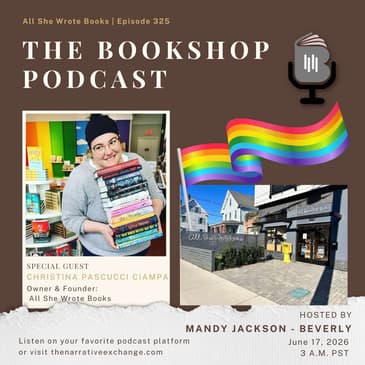
In this episode, I chat with Christina Pascucci Ciampa, founder and owner of All She Wrote Books, an intersectional, inclusive, feminist, and queer independent bookstore in the Boston area.
Shelf space is never neutral, and Christina has built a bookstore that treats that truth as a daily practice. We talk about how a mission-driven shop becomes a real refuge for readers who rarely feel represented in mainstream recommendations.
Christina shares her path from a decade in corporate marketing and sales to launching the store as a pop-up, then growing it into a community-centered bookshop with events, thoughtful curation, and a team empowered to lead. We get honest about the stress of small business ownership, what delegation really looks like, and why strong leadership is the difference between burnout and sustainability.
We touch on radical bookstores, community safety, and the modern challenges of organizing in an online world. We also dig into gaps in the publishing industry, the ongoing pullback in LGBTQ+ support, and why small independent presses and zines are crucial when big marketing dollars decide what gets attention. Finally, we land on reading as an empathy muscle, including a powerful recommendation, So Many Stars by Caro De Robertis, and why balancing heavy nonfiction with restorative fiction can keep you engaged without going numb and teach us empathy.
So Many Stars, Caro De Robertis
Subscribe for more conversations with authors and booksellers, share this episode with a fellow reader, and leave a review wherever you listen.
The Bookshop Podcast
Mandy Jackson-Beverly
Social Media Links
Welcome To The Bookshop Podcast
SPEAKER_01Hi, I'm Major Jackson Beverly, founder of the Narrative Exchange, featuring the Bookshop Podcast, the Lunch with an Author literary series in Southern California, writing workshops, and the Narrative Exchange Book Club. Here at the Bookshop Podcast, I explore the world of books through conversations with authors, independent bookshop owners, booksellers, and publishing professionals who keep literature alive. If you enjoyed the show, please subscribe, share it, and leave a review wherever you listen. You're listening to episode 325. First
Narrative Exchange Book Club Launch
SPEAKER_01up, a little bit of news regarding the Narrative Exchange. We have launched our book club. Now I understand if you're asking yourself, well, what makes this book club different? Well, most book clubs stop at discussion, but we go further. Inside the Narrative Exchange Book Club, you'll find direct access to working authors, behind-the-scenes insight into the writing process, opportunities to reflect, respond, and share your writing work. It's part book club, part writing space, part creative salon, all within one thoughtfully curated community. You can sign up for the Narrative Exchange Book Club at thenasarrativeexchange.com. Go to memberships, click on that, and you can sign in and become a member. There are three tiers that you can read about. The first one is completely free. We have our first book club event coming up on Wednesday, June 24th at noon with author Cecile Pinn, author of Wandering Souls and Celestial Lights. Cecile will be joining us from the UK. We're going to meet at noon PST on Zoom. To get the link, you need to become a member. So I look forward to seeing you then. I'm so excited to share this book with you and to share Cecile Pinn's ideas on writing, and particularly because writing in English is not her first language. So sign up at thenarrativeexchange.com, go to memberships, you can just sign up there. It's super easy. And I'll see you for our first Zoom chat with Cecile Pin June 24th at noon and that specific standard time.
Upcoming Zoom And Lunch Events
SPEAKER_01Bring your lunch and whatever you'd like to drink. Now the in-person Lunch with an Author literary series events I have coming up are with author Carrie Mayer, and she'll be talking about her new book, Summer of Love. On Wednesday, July 15th, we'll be at Magic Hour in Ohio for lunch at noon. And on Thursday, July 16th, we'll be at the University Club in Santa Barbara. Tickets are available at thenarrativeexchange.com. Just click on events and it'll take you right there. I hope to see you at one of these events, either online with the Zoom chat with Cecile Pinn or with Carrie Mayer talking about her new book, Summer of Love, in person in OHI and Santa Barbara.
Introducing All She Wrote Books
SPEAKER_01Okay, let's get on with the show. All She Wrote Books is an intersectional, inclusive, feminist and queer bookstore that supports, celebrates, and amplifies underrepresented voices through their thoroughly curated selection of books spanning across all genres. As a queer person and survivor of domestic abuse, owner and founder Christina Pascucci Chiampa went digging for stories that she could relate to and found that they were out there, but they tended to get less shelf space and be shortchanged by publishers and book reviewers. Being an avid reader, she often felt unrepresented by bookshelves and online recommendations, showcasing what was already popular. Hi, Christina, and welcome to the show. It's lovely to have you here. Thanks, Mandy.
SPEAKER_00I'm really excited to be here today.
SPEAKER_01Thank you. It's my pleasure. Well,
From Corporate Work To Pop Up
SPEAKER_01let's begin with learning about you. What were you doing before opening All She Wrote Books? And what made you decide to take the leap when you did?
SPEAKER_00It's a really great question. Um, so prior to All She Wrote Books, I actually worked in marketing and sales, and I worked in a very um, a very corporate culture, i.e., financial services and tech, uh, which is very, you know, interesting career choice. But uh I learned a lot through that time. And I think a lot of it has served me in what I do now at the bookstore. Uh, but that was originally what I was doing for almost 10 years. And then around year 10, 9, 10 was when I was like, I don't know if I want to do this forever. And uh I decided I was like, okay, like what can I do to kind of create some boundaries maybe with my full-time job? Because like I was kind of I was the person that definitely felt responsible a lot in her rules and was always the go-to person in many of her corporate roles. And so I didn't know how to turn off, which is sad. And you know, I know that there are a lot of people in the world that have to unfortunately be that way to be in the careers that they are and stuff like that. But for me, I was getting to a point where I was like, this is not how I want to live my life. And I was like, what can I do that maybe like would be something that okay, maybe it starts as a hobby, who knows? Like, or it becomes something. Um, which obviously, whoo, wow, what a concept. Um, so so I started it as a pop-up, and I literally was just like, I knew how to do sales and marketing, so it was very easy for me to put together a like a kind of a brand and what I wanted it to be, and and that I wanted it to be mission-based, and I wanted it to really feature books that I felt going into many independent bookstores in my area, Greater Boston, didn't necessarily highlight or have, unless you wanted to special order it, which I was like, okay, that's that's a little sad. And so I kind of just went down this path of like understanding maybe why, or like, but also being like, I want to answer the question why can't there be an independent bookstore that is what we are now, right? A queer feminist bookstore, you know. So that got me down a path of understanding kind of the fact that really honestly there was one at one point. And that's how I learned about new words and and things like that. So it kind of just opened up a lot of things for me to be like, okay, if this bookstore existed in the past, why can't it exist now? At the time when I started as a pop-up, it was 25 years that they hadn't been open. And I was like, okay, but can we change that? Especially in this very vibrant book like indie bookstore community that makes up Boston. It's a very interesting, you know, it was a very interesting question. It was a question I wanted to answer. And so that's kind of what started that journey a little bit. It was ultimately meant for boundary healthy setting. And instead, it turned into a side hustle, but it with an understanding of like, you know, what how much joy it gave me in my life and like how much of a sense of like people appreciating it
Leadership Stress And Delegating Well
SPEAKER_00so much.
SPEAKER_01Now, have you found that having your own business as I do, so I understand, it's a different kind of stress.
SPEAKER_00Yeah. No, it's a whole other level of stress. It's very, it's a very big different level of stress, right? Because you're paying for rent, you're paying for employees, you're paying, you are HR, you are the building supervisor, you are the person responsible for ordering, you are the person responsible for making sure that like all the communications for events and things like that to go smoothly and successfully is on you. And it's a lot. Um, I'm very fortunate enough though that I have really built a great team to this point where I don't feel that I'm holding all of that because I did for a very long time. You know, one of the things I had to learn as I went through this business is I can't hold on to everything.
SPEAKER_01And you've raised an interesting issue. And that is when you have your own business, there comes a point where you're just so exhausted, you're run out of steam. And things that might take a professional 30 minutes take me six hours. So for me, that was the point that I realized I was losing money because I was using my precious time to do things that somebody else could do in 30 minutes.
SPEAKER_00Oh, absolutely. It does. But it also, too, like especially if you have like an eager and willing staff and they're so engaged and so excited, that makes it even 10 times better. Um, we're very fortunate that we have a bookseller who loves children's in YA and middle grade specifically, and they are they focus in on that specifically. And that is something I used to do a lot of. But now this person has flourished to the point where we are hosting authors that they're having conversations with. It's amazing. And so, like, imagine when you can give that opportunity to somebody to to kind of guide it themselves. Obviously, you give them parameters, right? Because it can't be like too much, right? But it can be, you know, if you give a certain amount of leeway, I think the end product can be even greater. And I think that's the thing about leadership too, is when you are able to, you know, really instill confidence and respect amongst your peers, they're gonna want to do even more for you, even more than you necessarily asked. And I feel like that's that's such a testament to, you know, management, but also, you know, the values mission-driven place that we are. Because at the end of the day, my booksellers, you know, I love and respect them so much. They I can't do what I do, I can't even do this interview without them, right? Like they're making space for me to do other things in benefit of the bookstore, but also in general. It's that whole thing.
SPEAKER_01Yeah, I wish we could bottle up that sentiment and send it to DC.
SPEAKER_00Oh, seriously. I'd love to send it to DC. I'd love to send it to everywhere.
Radical Bookstores And Safe Community
SPEAKER_01Let's talk about radical bookstores because they've long been spaces for anti-racist, feminist, and leftist organizing. How do you see today's feminist and LGBTQ plus bookstores relating to that earlier tradition?
SPEAKER_00Yeah, it's a great question. I, you know, I think it's I think it's evolved since the 60s. Um, you know, I I I mean, uh to speak openly and frankly, I think some of the radical bookstores that did exist in the 60s and 70s also didn't accept necessarily trans women and certain other folks that are in the LGBTQ IA plus space, but in addition, also Black feminists as well. So I feel like there's a couple of, and I'm not saying it was all of them, there were a couple of pockets. So I want to clarify that I think from looking at it from where it was then to now, I think when we talk about that, we talk about truly bringing community together. And that means every walk of life, what wherever that is, and that especially means uplifting those marginalized communities that I just mentioned a minute ago and making sure that they are also front and center in the conversations and the things as well. So I think we're seeing more of that now, and I think that in turn is extremely important because I think we are learning how to organize and how to do things very differently than maybe necessarily was done in the past. I also think it's inspired like a whole kind of you know, genre, like different, like different aspects of different genres. Like, you know, trans fiction is so interesting. Like it the trans writers who write fiction, it's not just like sci-fi, but I'm talking like actual fiction is really, really super cool and very, very interesting. And so, like, that's an opportunity to really open that up too and and have those titles available. So I feel like it goes beyond just the organizing, but the organizing aspect is like we're seeing multiple groups of people coming together, right? And coming together for either one thing or, you know, multiple things. So it's a variation. And I think like that's kind of the thing. I also think, too, for us, like, I do think like there are definitely practices that were done in the past that absolutely are coming to the forefront. But I think it's very different, right? We have a technology piece to it that's at the sometimes the center of it. I don't love it per se. And um I do think that that can get distracting at times and distract away from what we're trying to do. So it's really like, how do you balance those pieces out in a way that allows for that ability to have that community in a safe space and in a way that's allows for people to speak freely and to voice their concerns or thoughts and feelings and not be ridiculed or posted online or something like that. And I think that's also really part of the mix of what we try to do as well.
SPEAKER_01Yeah, I think the feminist bookshops of today and the more modern radical bookshops are all about creating a safe space for community.
SPEAKER_00Yeah, absolutely. And I think like that is definitely, but that goes across, and I think this is kind of the caveat that I had with that is like in my research and understanding radical feminist bookstores from the 60s and 70s, again, like, yes, safe spaces were super important, but I think there was a bit of a distinction sometimes with that. And that was that to me is the part that I'm trying to kind of open up a little bit more. And I'm not the only one either, but like, and I think nowadays it's very, very different. So, meaning like the the safety of that is is very, very different.
Publishing Gaps Marketing And Small Presses
SPEAKER_01Let's talk about publishing because it's made visible strides toward a broader representation. But from your perspective as a bookseller, where do you still see gaps and what stories or voices remain underserved?
SPEAKER_00So I still think you know, certain stories. So we're kind of seeing that a little bit in publishing right now. With the bills that are being introduced, such as the one that's currently going through the house, which is concerning. Uh, we're also seeing, like in publishing right now, that there's been kind of a pullback a lot on printing and giving book deals to LGBTQ people. I still think we're missing like some pieces of it. I think there's been some progress. I don't know if it's necessarily enough. I think it's a good pat on the back for right now. I think, but it has had growth over the years. So I don't want to discount that, but I still don't think it's where it needs to still be. I think also in particular, we're seeing this now. For example, JD Vance is apparently having a book, and everybody, so we're gonna call it out. Barnes Noble wants to be an independent, right? So right now they're promoting that, thinking that that is worth their time. And we're seeing more and more of that as time goes on. And that to me is concerning.
SPEAKER_01Well, that kind of goes back to your past work in marketing. I mean, you see the power that marketing has.
SPEAKER_00It has super big power, especially with a place like Barnes and Noble. But I think the difference with places like ours is like, no, we're not gonna give that the attention. We're not even gonna give it the light that it doesn't deserve, period. You know, so our mission is really about like, okay, finding and seeking out those books that maybe wouldn't get that kind of marketing dollars behind it. And how do we then get that into the echo speed, the like the echo chamber ultimately of you know what what we're doing and like the kinds of topics that people want to read about in this community, right? Because they're not gonna want to read that, they're not gonna want to read even, you know, other ones that are coming out. I won't say who because that there's a lot coming out right now, but there's you know, there's definitely a mix of that. And that's that's mission, mission critical about like, yeah, how do we take those titles, the ones that don't get the marketing dollars, that maybe don't get even the budget to necessarily do an author tour.
SPEAKER_01Well, you know what? I do want to give a shout out to the small independent presses around the globe who are publishing books, they're taking a chance on books that the big publishers, the trad publishers would not. And these are incredible voices, and I'm so grateful to them. And it's also great to see uh people writing zines and putting them online or printing them up, putting them in independent bookshops. I love that, and I think zines are incredible. Zines are amazing, they are, and they give people a voice without thinking, oh, am I gonna get approved by a publisher?
SPEAKER_00Yeah, yeah, and it's true because that's the thing. There's been so many different things that don't, you know, traditional publishing is extremely difficult. It's extremely difficult to break. Um, I've met many authors in my time that it took them 10 years to get the book into the world. That's so much time. Like so much time when if it was actually published 10 years ago, I think it would look, I think publishing would look very different. And I think that's that's the thing. But zines allow for the ability to get that information out quickly. I also think it makes it a lot more digestible for folks as well, right? I also think to your point about talking about smaller independent publishers, the power that they have had in bringing stories to the forefront that don't get talked about or don't get recognized or any of that, like that is huge. That is like, and that's why like we stock so many of them in general, because they are talking about stories and topics and things that no mainstream publisher is gonna necessarily touch, which is unfortunate. Look, the publishing industry, I think last year alone published over four million books. Four million. That's that's a lot of books. But what are you what are the topics? And if you look at the topics, it's a little like, oh, we've kind of backed it up. We went backwards a lot. Yeah, we went backwards big time. We did, and that's the part that concerns me the most, which is why like places like mine need to exist because we're the ones that are like, no, we're demanding for this, we're asking for this. My purchasing power is telling you, the publisher, what that means and what that needs to look
Displacement Rent Hikes And Visibility Risks
SPEAKER_00like.
SPEAKER_01Christina, what has building this store asked of you personally, and what have you had to risk or give up along the way?
SPEAKER_00That's a great question. So, like, I think that what I've had to give up is definitely like a personal life. Because one of the things that you do, especially in this age of technology and in social media, you have to put yourself out there. And sometimes in very big situations, i.e., when you're being displaced and you need to move and you need to raise that money to do that. It was the first time I've ever been on camera.
SPEAKER_01Can you share with our audience why you had to move?
SPEAKER_00Uh, absolutely. Let me explain that. So, unfortunately, in 2023, we um our landlord at the time uh didn't see the value that we were bringing to that particular part of the neighborhood in Somerville. And so they pretty much indirectly displaced us by forcing our rent up 130% over two years, in addition to not repairing properly HVAC systems that we spent over $8,000 actually repairing ourselves. Um, so there was a lot of turmoil that went down, and we just kind of well, more of I saw the writing on the wall. I saw that they didn't want us there, they didn't care about a small business being in that space and that they were going to find a way to replace us one way or another with a chain, which is what they ended up doing. And so um I took it upon myself to find a new space. So the space that we're in now, which is 75 Washington Street, it's been a little over two years now. It's a much smaller space than what we had. What we had was almost 12, 1,500 square feet. It was great. It was also a box, it was an ugly gray box. And and I'm just being honest, because when you put up strip malls like that and outdoor malls like that, they look the same. There's no character. You have to spend none. And so to me, at that point, I was like, we want the personality to show through. We want our it's so funny. Um, we had a A particular, uh, very famous person come in a long time ago, last year, not that long ago. And she talked about when she came in, she did a big sigh. She was like, Oh, now this is what this place makes me feel, and I love it. And I was like, oh wow, okay. She's like, this feels like a big hug of kindness. And that to me is what I've always wanted for this space is for someone to feel like they're getting the biggest hug if they want it. Because not everybody wants to be hugged, and that's okay. But for those that do, it's the hug that is there and that it's not forced and it's not put in your face. When you come into the space, you feel it. When we came into this space, that was the biggest goal for me. And yeah, we did decrease in size, but that didn't mean the mightiness of this team of this bookstore necessarily changed with that. I think it looks gorgeous. Thank you. So, like again, like all of those things combined is what makes us, but going back to kind of being the to answering your question about the personal piece, yeah. Like I had to give up being anonymous because the only place that you necessarily saw me was in the bookstore, but you didn't make the connection. And now you do. And so I've given up a little bit of that. So, like in certain places that I go, like I'll get, you know, I'm I promise you I'm not a celebrity. I promise I am not at that level. No, no, no. I'm still absolutely like I love people and people and people make me happy and all that. But there are definitely places that I go outside of the bookstore where I do get recognized, and like it's great, it's wonderful sometimes, but other times it's like, oh, can you just leave me be? Like, I don't mean to be rude, but I really just want to watch this show or like performance or something. And it happens, it happens, but that's kind of the thing, and that also means the further extreme, which is being doxxed. Um, I've been doxxed, um, I've been harassed, I've been threatened, and that is something that definitely escalates once you put your face out there. That is something that I've had to give up. But at the same time, though, it's made the opportunity for me to be a helpful force. So everybody loves to joke about the eldest daughter thing, right? Like, eldest daughter, she gets it done no matter what. I am that woman. I am an eldest daughter. I am the lady that's like, don't worry, I got it. Don't worry, I'm gonna fix this. Don't worry, I got you. And it's true, I've been that way my whole life. Now it's just on a very different level. But I have the ability to help people in times of need, in just times of grief or sadness, or in times of happiness. The range is so big that I have that ability to do that as the not being the, you know, losing that part of my personal peace, you know, has been really amazing. So it's taken some time to embrace, but I feel like now that I've done it for about a couple of years now, I feel like I've definitely embraced it and that it's okay. Yeah.
SPEAKER_01I completely agree. I think that embracing our communities is what is needed now and being there for each other. We can't do a lot about the big picture, uh, especially in the United States right now. Uh, but we can vote and we can embrace our communities.
Books That Build Empathy
SPEAKER_01Okay, now finally, is there a book that you would like to see more people reading right now?
SPEAKER_00That's so there's so many. I'm sorry. And I'm a book snob, okay? I'll admit it for the record. I'm a snob. Um, what I will say, one book that I wish more people were reading as um, and one that's more recent is So Many Stars by Caro de Roberts. Yeah, Robertis. So Caro is an amazing author, has written a ton of amazing queer fiction, mostly historical. And they what they did was they did an oral kind of history of trans, non-binary, and two-spirit people across the US. And they did like these amazing kind of profiles on each of these people. And it was just, but the way that they did it, it was all this just beautiful storytelling. You felt like you were ultimately reliving these people's lives in the time frames that they were happening. And I feel like that is so powerful. They also included like data to go with it, but for the most part, it was really just storytelling and storytelling at its finest. And I absolutely adored it, and I want more people to read it because, and it is coming out in paperback, so that is a lifesaver right there, right? So many stars, Cara De Robertis is just a gem. And I love that book, and I want more people to read it because I feel like this goes back to what you were talking about of not only just voting and being in community and having that control in community. I think there's another piece of this, which is building back that empathy that we have seemed to have lost entirely. And I'm saying that across the board is and we all can learn from reading personal narratives that are different from our own and building back that empathy. Because as a kid, that is how I learned that people that didn't look like me had similar experiences to me because my pop my public library was wonderful enough to carry those books and not stop me from reading them. That's really important. So that's one that I'm like, if everybody could read that, I want them to. And I and look, it's not the most uplifting stories. Some of them are sad, but some of them have so much queer joy and beauty in them that I feel like the ebbs and flows of life is just sometimes, and I know life is hard right now. Like I'm not sitting here saying it's a great time to read nonfiction. It can be hard, but I think that if we can take a moment and really read books of different perspectives, even the happy ones or the sad ones, I think it makes a difference.
SPEAKER_01Yeah, I agree. And I find that if I'm reading a nonfiction piece that is particularly heavy, um, for example, on civil rights, social justice, then I beside it, I also have something like TJ Clun's House in the Cerulean Sea. You have to have something to give it balance. No, you do, absolutely. Otherwise, you'll go nuts. Yeah, and I also believe that reading well-written fiction helps develop empathy. And I know I'm preaching to the converted here with you. I love that. I think it's imperative that we have the facts of nonfiction, but I've found too that a lot of nonfiction writers are actually writing creative nonfiction now, which I find easier to read. And I also believe that it's through stories that we learn.
SPEAKER_00Yeah, a great book that does that, that yes, is is definitely has some sad moments, is The Lilac People by Milo Todd. That is a beautiful, non uh beautiful historical fiction about ultimately the time before the institute was burned down, a trans institute, and then after World War II. So, like there was it's ultimately two different time frames, but with the same characters, and it's just beautiful. And I've had the privilege of knowing this author so much, and um them being able to literally write it, took them 10 years to bring this to life, and that to me is just like you can't ask for anything more than that. Um, but I do agree, I do balance the heavy nonfiction with the fiction. Um, one in particular I did that with is the book of Luke. It's reality television, just gay, and it's really fun and silly. And I loved it, it was awesome. And so, to your point though, I'm also a very similar reader as well. I have to balance the two together if I don't, it's
How To Visit And Final Thanks
SPEAKER_00like, whoo!
SPEAKER_01Christina, I can see that you're starting to kind of look around the store, so I should probably let you go. It's been wonderful having you on the show, and thanks for opening your store, All She Wrote Books.
SPEAKER_00Thanks, Mandy. I really appreciate it, and I really appreciate this opportunity to chat with you. And yeah, anybody can come and visit us in person, but they can also see us online. So that's yeah, what's your um website? Yeah, so it's all she wrotebooks.com. Very easy. And uh, we're on Instagram at all she wrote books one word. Uh, we also have a newsletter as well. It goes out weekly on Sundays. It's the weekly fix of all she wrote books. So if you're interested, you can sign up on our website. But other than that, yeah, and then we're open six days a week.
SPEAKER_01You've been listening to my conversation with Christina Pascucci Chiampa, founder and owner of All She Wrote Books in Boston.
Credits And Closing Words
SPEAKER_01Thank you for joining me on the Bookshop Podcast. This show is written and produced by me, Mandy Jackson Beverly, with music by Brian Beverly. My personal assistant is Kaylee Dishinger, and my graphic designer is Alexandra Mooney. If you enjoyed the episode, please follow, share, and leave a review wherever you listen. For more information, go to www.thenarrativeexchange.com. Until next time, here's to the books that shape us and the bookshops that bring us together.